Vegetarian Food in Seoul: Vegan Dishes to Order and Korean Phrases
Which Korean dishes hide anchovy broth, fish sauce or salted shrimp, the Korean phrases to order vegan, and where to find temple food and vegan places in Seoul.
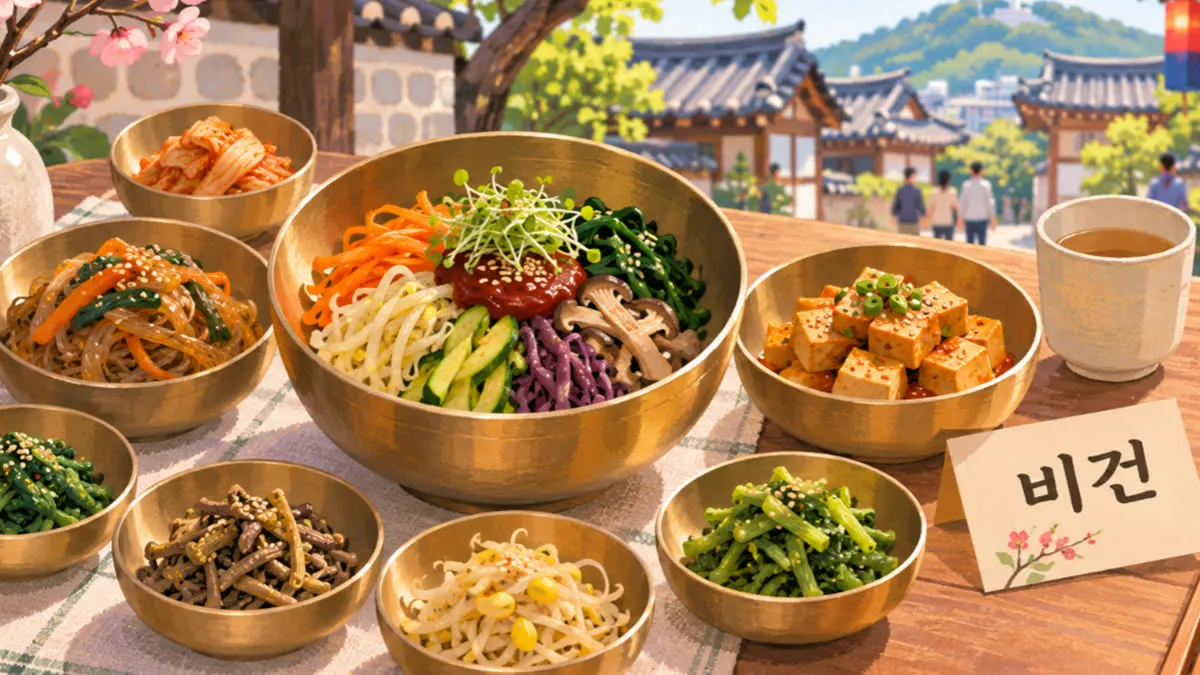
You can eat vegetarian or vegan in Seoul, but in ordinary Korean restaurants the trouble is the base of the dish, not the main ingredient. Most soups and stews start with anchovy or beef broth, and most kimchi contains salted shrimp or fish sauce. Eat at vegan or temple-food restaurants when you can. Everywhere else, say exactly what you don't eat, including broth and seafood.
Ingredients that make a vegetable dish non-vegetarian
Learn these words. They are what to ask about, and what to look for on menus and labels.
| Korean | Romanization | What it is | Where it turns up |
|---|---|---|---|
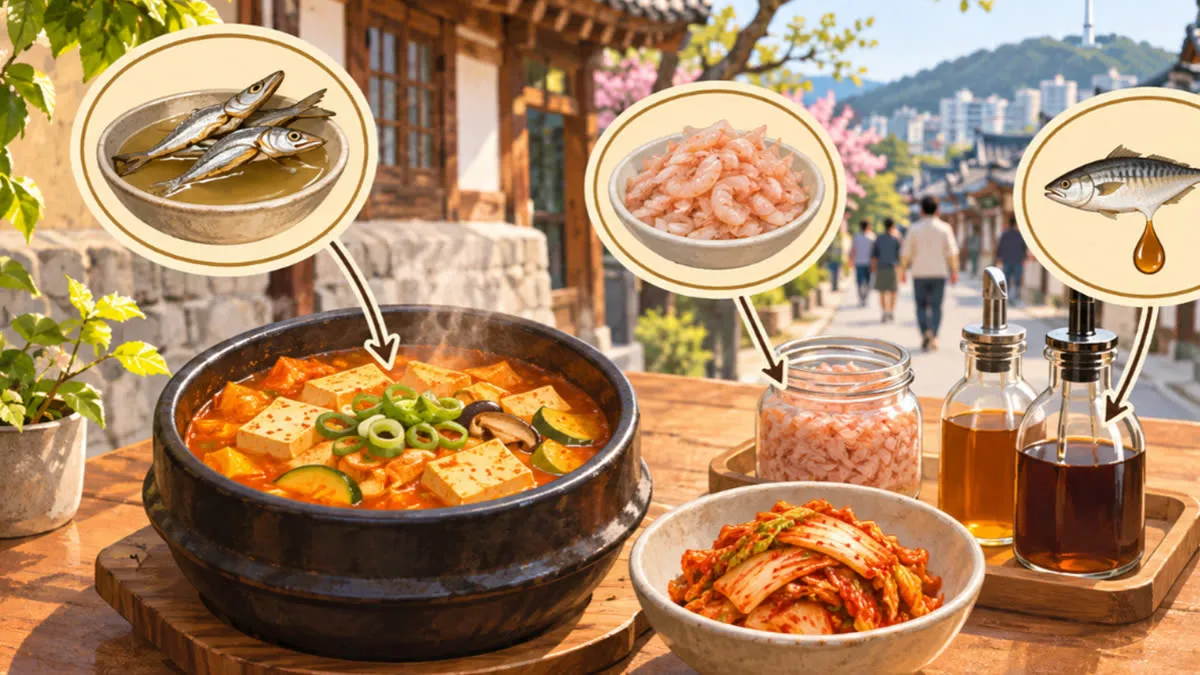
| 멸치 육수 | myeolchi yuksu | Anchovy broth | Most soups and stews, including doenjang jjigae and sundubu jjigae |
| 액젓 | aekjeot | Fish sauce | Kimchi, seasoned vegetable side dishes (namul) |
| 새우젓 / 멸치젓 | saeujeot / myeolchijeot | Salted shrimp / anchovy paste | Kimchi, including most white kimchi (백김치, baek-kimchi) |
| 어묵 | eomuk | Fish cake | Tteokbokki, street snacks |
| 계란 | gyeran | Egg | Pajeon batter, bibimbap topping, gimbap |
| 굴소스 | gul soseu | Oyster sauce | Japchae, Chinese-Korean stir-fries |
Kimchi is the one that catches most people, because it arrives free as a side dish. Treat it as non-vegetarian unless the restaurant calls it vegan kimchi (비건 김치, bigeon gimchi). The same goes for most namul side dishes, which are often seasoned with fish sauce. Some commercial gochujang (chili paste) brands also contain fish sauce, so strict vegans should ask about it.
Korean dishes you can ask a kitchen to make vegetarian
No ordinary dish is safe by default. These are the ones that need the smallest change.
- Bibimbap (비빔밥): usually topped with a fried egg and often with minced beef. Ask for no meat and no egg, and ask about the gochujang if you are vegan.
- Japchae (잡채): the sweet potato glass noodles are vegan, but japchae normally has meat and may be seasoned with oyster sauce. Ask for it without meat.
- Vegetable gimbap (야채김밥, yachae gimbap): rice and seaweed rolled around pickled radish, spinach, carrot and burdock. Ask for no egg. At a convenience store, check the allergen line on the label (see below).
- Doenjang jjigae (된장찌개): the soybean paste is plant-based; the broth usually isn't. Order it only if the kitchen agrees to use vegetable broth (채소 육수).
- Potato pancake (감자전, gamjajeon): a safer choice than green-onion pajeon, whose batter contains egg and which restaurants often fill with seafood (haemul pajeon). Ask anyway.
Skip these unless they are clearly marked vegetarian or vegan: tteokbokki (fish cake, often fish stock), sundubu jjigae (seafood or anchovy broth), miyeokguk seaweed soup and tteokguk rice-cake soup (beef or anchovy broth), and anything with kimchi in the name (kimchi jjigae, kimchi fried rice).
If nothing on the menu works, you can almost always order a bowl of plain steamed rice (공깃밥, gonggitbap).
What to say when you order
채식주의자 (chaesikjuuija, vegetarian) is understood in many Seoul restaurants, but cooks often don't count fish, shrimp or broth as meat (고기, gogi). Name each thing separately. More everyday lines are in our Korean Phrases for Travelers.

| English | Korean | Say it |
|---|---|---|
| I'm vegan. | 저는 비건이에요. | jeoneun bigeonieyo |
| I don't eat meat or seafood. | 저는 고기랑 해산물 안 먹어요. | jeoneun gogirang haesanmul an meogeoyo |
| Does this have meat or seafood in it? | 이거 고기나 해산물 들어 있어요? | igeo gogina haesanmul deureo isseoyo? |
| Is there anchovy broth in it? | 멸치 육수 들어가요? | myeolchi yuksu deureogayo? |
| Without meat, please. | 고기 빼 주세요. | gogi ppae juseyo |
| Without egg, please. | 계란 빼 주세요. | gyeran ppae juseyo |
| No fish sauce, please. | 액젓 빼 주세요. | aekjeot ppae juseyo |
| Can you make it with vegetable broth? | 채소 육수로 만들어 주실 수 있어요? | chaeso yuksuro mandeureo jusil su isseoyo? |
| Do you have a vegetarian menu? | 채식 메뉴 있어요? | chaesik menyu isseoyo? |
Save the Korean as a screenshot. In a busy restaurant, showing the screen is faster than pronouncing it, and staff can carry it to the kitchen. If the answer is a shrug or 잘 모르겠어요 (I'm not sure), assume the broth is not vegetarian and order something else.
Temple food around Jogyesa Temple, Jongno
Korean Buddhist temple food (사찰음식, sachal eumsik) uses no meat, fish, eggs or dairy. It also leaves out the five pungent plants (오신채, osinchae), which include garlic, green onion and Chinese chives. Flavor comes from soybean pastes, sesame, perilla and seasonal vegetables. Korea's heritage authority designated temple food a national intangible heritage in May 2025. For strict vegans this is the easiest kind of Korean meal to trust. One HappyCow listing does flag honey in some drinks, so ask if you avoid honey.
Two places share one building at 56 Ujeongguk-ro, Jongno-gu, the Templestay Information Center across the road from Jogyesa:
- Balwoo Gongyang (발우공양), 5th floor. A set-course restaurant run by the Jogye Order. Its HappyCow listing (last updated April 2025) gives these hours: Monday to Saturday, lunch 11:30–15:00 (last order 14:00), dinner 18:00–22:00 (last order 20:45), closed Sundays. The listing says reservations are required and lists the phone as 02-733-2081. It puts the price at KRW 30,000 or more per person (about USD 21). Diners who posted between 2021 and 2023 mention courses at KRW 35,000, 45,000, 60,000 and 65,000. One reviewer reported an earlier last order than the listing shows. Call to confirm the current courses, prices and last order when you book. We could not load the restaurant's own site (balwoo.or.kr) on November 19, 2026.
- Temple Cuisine Culture Experience Center (한국사찰음식 문화체험관). Runs cooking courses, one-day experiences and special lectures. On November 19, 2026 its Korean site listed a 12-week beginner course for KRW 30,000 (Tuesdays, 10:00–12:00, from November 17, 2026) and special lectures for KRW 50,000–60,000. New programs open for booking on the last Tuesday of each month at 9:30, for classes two months ahead, and you get a full refund if you cancel up to three days before. The English site (koreatemplefood.com/EN) had no classes scheduled when we checked. Call 02-733-4650 to ask whether a class can be done in English.
To eat temple meals at a temple overnight, see Temple Stay in Korea.
Itaewon and Hongdae for vegan restaurants and cafés
Fully vegan restaurants and cafés are concentrated in Itaewon (Yongsan-gu) and Hongdae (Mapo-gu). HappyCow lists more than 100 vegan and vegetarian places in Seoul, most of them in these two areas. Many serve Western food, which matches Seoul's own count: in the city's 2020 survey, 44.1% of listed places were Western restaurants and 34.0% were Korean.
To find places near you:
- Naver Map or Kakao Map: search 비건 (vegan) or 채식 (vegetarian), then check the listing's opening days, because many small places close one day a week. Our Best Map App for Korea explains how to set them up in English.
- HappyCow: the most complete English-language listings, with recent reviews.
- Smart Seoul Map (스마트서울맵, map.seoul.go.kr): in January 2021 the city put its vegetarian restaurant list on this map. On the main screen, tap the icon with a spoon and fork to show the listed places. The list comes from a 2020 survey: it found 1,555 restaurants with vegetarian dishes and published the 948 that agreed to share their details. Gangnam-gu had the most (110), followed by Jongno-gu (70), Songpa-gu (68), Mapo-gu (57) and Yongsan-gu (54). The data is about six years old, so check that a place is still open on Naver Map before you go. The city's text version of the list redirected to an error page when we checked on November 19, 2026.
Vegetarian labels on Korean menus
Seoul's list and many menus use the international vegetarian categories. Check which one a dish is marked with:
- 비건 (bigeon): vegan, no animal products
- 락토 (rakto): lacto, dairy allowed, no eggs
- 오보 (obo): ovo, eggs allowed, no dairy
- 락토오보 (rakto-obo): lacto-ovo, eggs and dairy allowed
- 페스코 (peseuko): pescatarian, so fish and seafood are allowed. This is not vegetarian in the usual English sense.
- 일반식 (ilbansik): a regular dish that the restaurant can make vegetarian on request. Tell them which version you need.
On packaged food, look for a 비건 인증 (vegan certified) mark.
Convenience stores, bakeries and barbecue restaurants
- Convenience stores: fruit, nuts, tofu and plant milks are easy. Ready meals and gimbap often contain ham, fish cake or egg. Instead of the full ingredient list, scan the allergen line for 우유 (milk), 계란 (egg) and 새우 (shrimp), or point Papago's camera translation at the label. More on what the stores stock is in Korean Convenience Stores.
- Bakeries: most use butter, milk and eggs. Search 비건 베이커리 (vegan bakery) on a map app.
- Korean barbecue: you can grill mushrooms and eat lettuce wraps, but the vegetables cook on the same grill as the meat, and the side dishes and dipping sauces may contain fish sauce or salted shrimp.
Sources
Last checked: — Prices, hours and rules in Korea change often; check the official pages below before you go.
- Seoul Metropolitan Government (Mediahub) – 948 vegetarian restaurants published online
- Seoul Metropolitan Government (Mediahub) – Finding vegetarian places with Smart Seoul Map
- Seoulstart – Vegetarian Food in Korea Guide
- HappyCow – Balwoo Gongyang, Seoul
- Temple Cuisine Culture Experience Center (Korean)
- Temple Cuisine Culture Experience Center (English)
Facts were checked against the sources above, and the article was written by Seoul Sidekick with the help of AI tools. Report an error