Temple Stay in Korea: What a Day Looks Like, Cost and How to Book
Temple stay in Korea: the one-night schedule from afternoon check-in to dawn chanting, 2026 prices of 60,000–120,000 won, and booking on templestay.com.
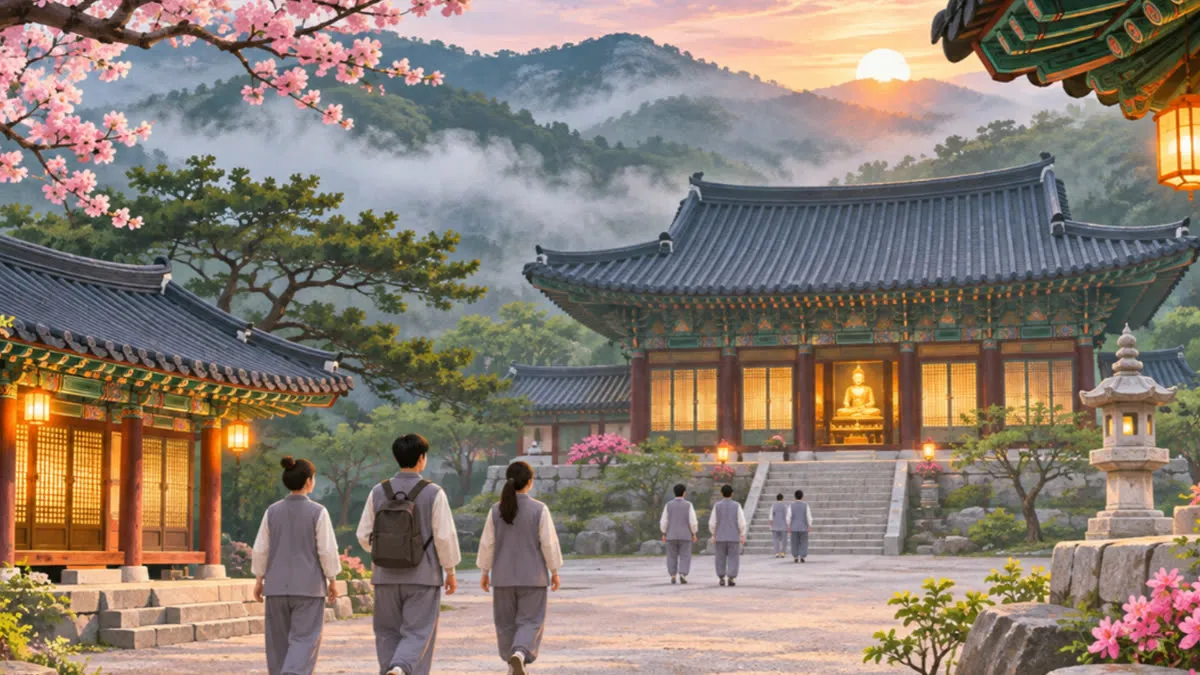
A temple stay (officially spelled Templestay) is usually one night at a working Buddhist temple. You check in around 2–3 p.m., join chanting at about 4 a.m. and leave around noon to 1 p.m. You book on templestay.com, which has an English version at eng.templestay.com. On November 19, 2026, the overnight programs we checked cost 60,000 to 120,000 won (about US$41–82) per adult per night, with meals included. You don't have to be Buddhist.
The program is run by the Cultural Corps of Korean Buddhism (대한불교조계종 한국불교문화사업단), part of the Jogye Order. Each temple sets its own schedule, price and refund rules. All of them list programs and take bookings on the same central site.
The three program types and who each suits
| Type | Korean name | Length | What you do |
|---|---|---|---|
| One-day | 당일형 | About 2–3 hours, often starting at 10 a.m. or 1 p.m. | Temple tour, meditation, tea ceremony |
| Experience | 체험형 | One night, often on weekends | Chanting, 108 bows, formal monastic meal, meditation, a craft such as a lotus lantern or prayer beads |
| Rest | 휴식형 | One night or more | Few or no set activities. The English site's description: "Do nothing but relax." |
The Korean FAQ suggests the experience program if you have never done a temple stay before. It suggests the rest program if you want time alone to think, and the one-day program if you only have a few hours. You can book more than one night. The English FAQ says the maximum is usually about ten days, but each temple sets its own limit.
A one-night schedule, hour by hour
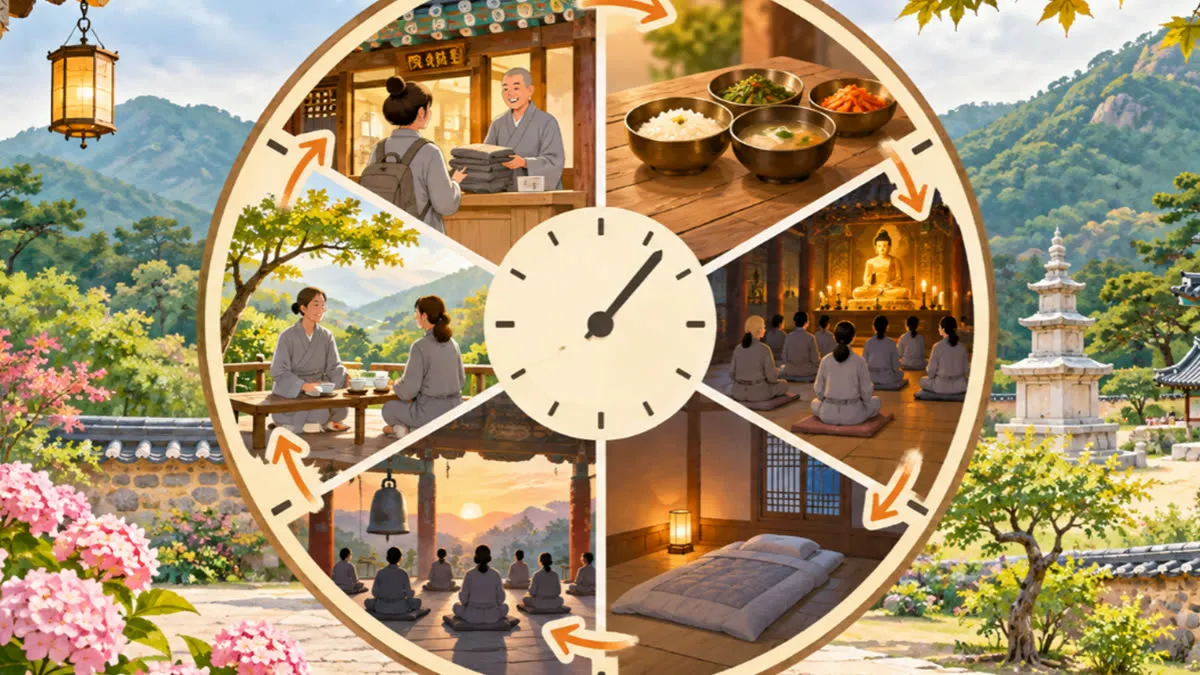
This is the published schedule for the rest program at Golgulsa, a temple near Gyeongju known for seonmudo, a Buddhist martial art. Guests on this rest program can also join the experience-program activities at the same price. The temple says the schedule can change.
| Time | What happens |
|---|---|
| Day 1 | |
| 14:30 | Registration and check-in |
| 15:00 | Seonmudo performance (none on Mondays or Tuesdays, and nothing replaces it) |
| 16:10 | Orientation |
| 16:30 | Seonmudo practice |
| 17:40 | 108 bows |
| 18:00 | Dinner |
| 21:00 | Lights out |
| Day 2 | |
| 05:00 | Wake up |
| 05:30 | Dawn chanting |
| 06:10 | Walking meditation |
| 06:30 | Breakfast |
| 09:00 | Morning seonmudo practice |
| 10:50 | Tea with a monk (groups of 5 or more, weekdays only) |
| 11:40 | Lunch |
| 12:00 | Check-out |
| 13:10 | Optional traditional archery, 20,000 won per person |
Other temples run a similar day, but many start dawn chanting at about 4 a.m. rather than 5:30. The Korean FAQ says every activity is voluntary. If you are tired or unwell, tell the staff which sessions you want to skip and rest in your room. If the 108 bows conflict with your own religion, you can sit quietly while others bow.
What you pay in 2026
Prices usually cover your room, all meals during the stay and the scheduled activities.
| Temple / program | Adult, per night | Source and notes |
|---|---|---|
| Golgulsa (Gyeongju), rest | 120,000 won (~US$82) | Official listing, valid to December 31, 2026. School-age children also 120,000 won; preschoolers 60,000 won |
| Daewonsa (Sancheong, Jirisan), rest | 60,000 won (~US$41) | Third-party blog, June 2026. Bookable for 1 to 7 nights. Solo guests must book a single room |
| Daewonsa, experience | 70,000 won (~US$48) | Same blog. One night only |
The Daewonsa figures are not from the official site, so check the temple's templestay.com listing before you pay.
Things that change the price:
- Room type. You normally share a room with guests of the same gender. The Korean FAQ says large halls hold 15 or more people and regular rooms hold 4 to 8. Some temples offer a private room or a room for 2–4 people for an extra fee per person. The English site calls this "Option pay."
- Discount campaigns. The official notices page lists seasonal deals. The 2026 special templestay for foreigners cost 30,000 won for one night and ran September 1–30, 2026, so it is over. A November 2026 campaign, 「11월 여행가는 달 행복두배 템플스테이」, opened extra places on October 26, 2026. The Daewonsa blog says it costs 30,000 won a night, but we did not find the price on the official notice. Check the notices board at templestay.com for current dates and places before you plan around a deal.
- Paid extras, such as Golgulsa's archery session (20,000 won).
How to book on templestay.com
- Choose a temple. On eng.templestay.com you can search by region and program type. Not every temple runs programs in English. The English FAQ says four UNESCO World Heritage temples offer English programs for foreigners: Beopjusa, Bulguksa, Magoksa and Haeinsa. For an easy trip from central Seoul, the FAQ lists seven Seoul temples: Bongeunsa, Geumsunsa, Hwagyesa, Jinkwansa, Jogyesa, Myogaksa and the International Seon Center. It does not say whether those run in English, so check each program page.
- Read the program page. It lists the schedule, prices by age, check-in time, what to bring, rules and refund policy. These differ from temple to temple.
- Pick a date on the calendar and pay online. Some dates are closed. Booking deadlines differ: Golgulsa stops taking bookings one day before the program starts.
- Fill in the application form honestly. Daewonsa, according to the blog we checked, requires you to list illnesses and medication. If you leave something out and a problem arises, you can be asked to leave with no refund.
- Save your booking details. The English FAQ says some temples do not send a confirmation letter. You don't need to bring one, because each temple keeps its own guest list. To check a booking, email [email protected] with your name, the date and the temple.
If you need to cancel or change dates
Each temple sets its own refund rules. At Golgulsa you get 100% back if you cancel three days before, 50% two days before and 10% one day before. If you cancel on the day, you get nothing back. A transfer fee is deducted if one applies. To change dates or fix a booking problem, contact the temple directly or email [email protected].
Booking in person in Seoul
The Templestay Information Center is on the first floor of the Templestay Center, 56 Ujeongguk-ro, Jongno-gu, across the street from Jogyesa Temple. It is open every day from 09:00 to 18:00 and closes on January 1, Seollal and Chuseok. Phone: 02-2031-2000.
- Line 1, Jonggak Station, Exit 2: walk about 5 minutes toward Jogyesa.
- Line 3, Anguk Station, Exit 6: walk about 5 minutes toward Jogyesa.
Balwoo Gongyang, a temple-food restaurant, is on the fifth floor of the same building.
Getting to a rural temple on time
Check-in times are fixed, and orientation starts soon after. Rural buses can be infrequent, so work out your route before the day. Golgulsa's page gives this route:
- From Singyeongju KTX Station, take bus 50, 51, 60, 61, 70 or 700 to Gyeongju Intercity Bus Terminal.
- From the stop across from the terminal, take bus 100, 100-1, 150 or 150-1 to the Golgulsa/Girimsa entrance stop (골굴사/기림사 입구).
- Walk about 13 minutes to the temple. The temple warns that its online map is not accurate.
For how intercity trains and buses work, see day trips from Seoul by public transport and KTX booking for foreigners. If you have a question before you go, call the temple during office hours. Golgulsa answers on 054-775-1689 from 9:00 to 17:00.
What to pack
The English FAQ says most temples provide only soap, toothpaste and a uniform (a vest and loose trousers). Wear the uniform during the program. Bring:
- A towel. Golgulsa says it does not lend towels, for hygiene reasons.
- Shampoo, a toothbrush, face wash and a hair dryer if you need one
- Underwear, socks and a change of clothes
- A thick layer such as a cardigan or jacket. The Korean FAQ says mornings and evenings are cold in every season except midsummer, and in late November nights are already cold.
- Shoes you can slip on and off, because you take them off at every hall
- Earplugs if you are sleeping in a shared room
Temple rules that get guests in trouble
- No alcohol, smoking or loud talk. Golgulsa also bans flashy or revealing clothes and going out with other participants.
- Men and women sleep in separate rooms, even married couples. The English FAQ calls this a fixed rule.
- The gates close to outsiders after 10 p.m., according to the Korean FAQ.
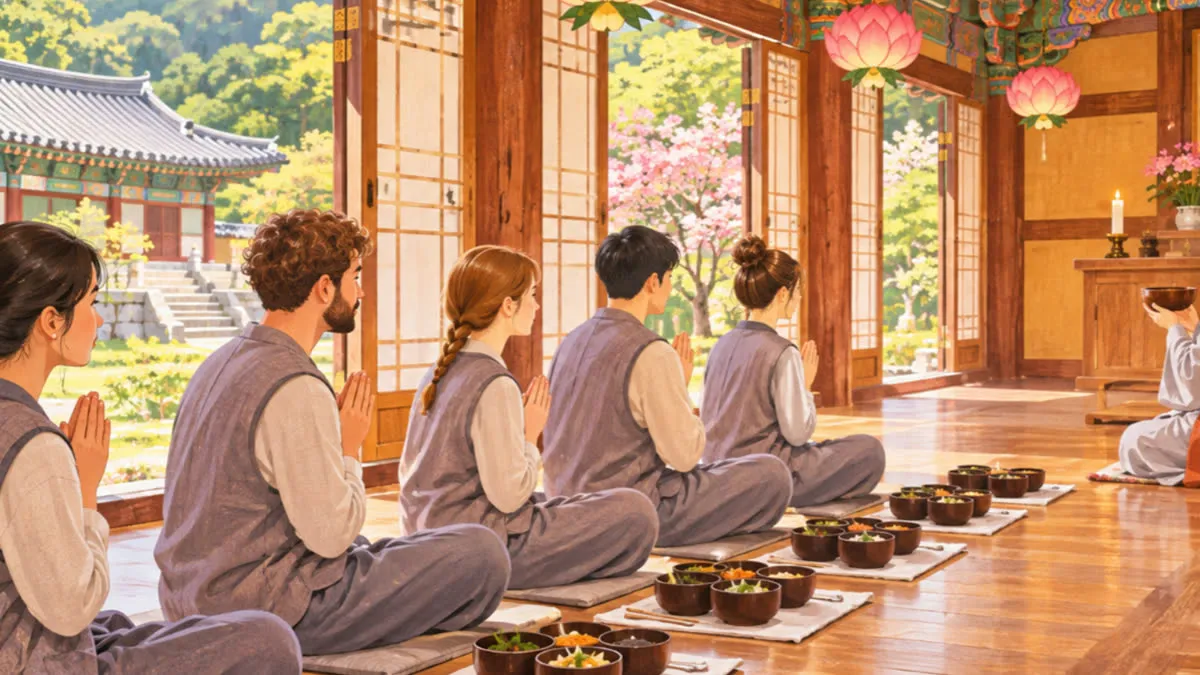
- The formal meal (balwoo gongyang) follows a set order. Staff explain it first. Take only what you will finish.
- Meals are vegetarian. Temple food uses no meat, eggs or instant food. It also leaves out five pungent plants, including garlic, green onion and chives. Tell the temple about any allergies when you book. For eating out after your stay, see vegetarian food in Seoul.
- Children need an adult. At Golgulsa, anyone of high-school age or younger must come with a guardian.
A few words of Korean help with monks and office staff. See Korean phrases for travelers.
Sources
Last checked: — Prices, hours and rules in Korea change often; check the official pages below before you go.
- Templestay – What is Templestay (English)
- Templestay – English FAQ
- Templestay – Information Center
- Templestay – How to get there
- 템플스테이 자주 묻는 질문 (Korean FAQ)
- 템플스테이 공지 및 이벤트 (official notices)
- Golgulsa rest-type templestay program page (templestay.com)
- Daewonsa templestay booking guide (gusle.kr, third-party)
Facts were checked against the sources above, and the article was written by Seoul Sidekick with the help of AI tools. Report an error