Halal Food in Seoul: Itaewon, Certified Restaurants and Prayer Rooms
Halal food in Seoul: the 3 KMF-certified restaurants, the Itaewon mosque street, COEX and airport prayer rooms, and what to ask before you order.
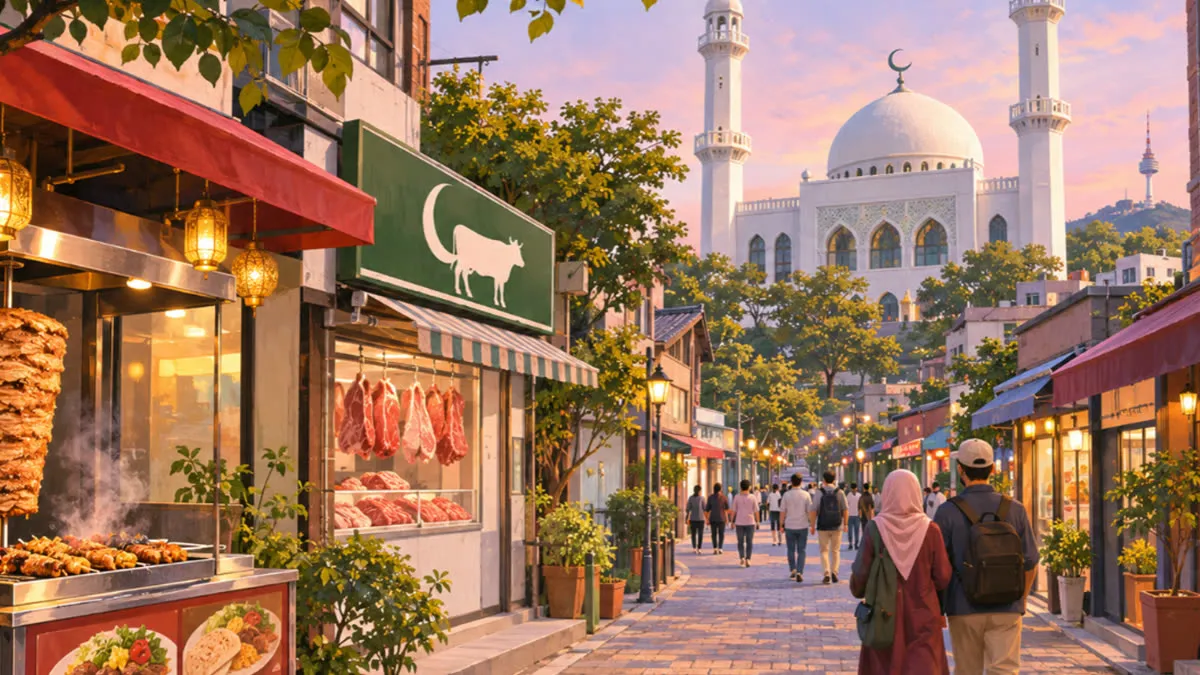
Most of Seoul's halal food is on one street in Itaewon: the slope up to the Seoul Central Mosque, a short walk from Exit 3 of Itaewon Station (Line 6). Only three restaurants in Seoul are listed as certified by the Korea Muslim Federation (KMF). They are EID Halal Korean Food and Kervan in Itaewon, and a second Kervan in Starfield COEX Mall in Gangnam. Anywhere else, you are choosing between Muslim-owned places, restaurants with a few halal dishes, and seafood or vegetable meals whose ingredients you check yourself.
We checked the listings below against the sources we opened on November 19, 2026. Restaurants close and certificates lapse, so call before you make a special trip.
The three KMF-certified restaurants
| Restaurant | Food | Address | Phone |
|---|---|---|---|
| EID Halal Korean Food | Korean | 67 Usadan-ro 10-gil, Yongsan-gu (about 5 minutes' walk from the mosque) | 070-8889-8210 |
| Kervan (Itaewon) | Turkish | 190 Itaewon-ro, Yongsan-gu | 02-792-4767 |
| Kervan (COEX) | Turkish | Starfield COEX Mall B1, 524 Bongeunsa-ro, Gangnam-gu | 02-556-4767 |
Source: Seoulstart halal directory, checked November 19, 2026.
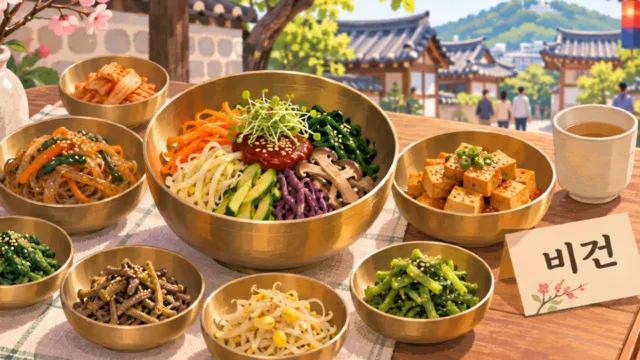
EID is the place to go if you want Korean food made with halal meat. The Seoulstart directory describes it as a fully halal kitchen with no pork or alcohol. A 2015 Korea Herald interview lists bibimbap, samgyetang (ginseng chicken soup), bulgogi and grilled fish on its short menu. The menu may have changed since, so check it on Naver Map or Kakao Map before you go. The same interview noted that the restaurant had to find halal gochujang and doenjang, because most brands of these pastes contain alcohol. That matters if you order Korean food anywhere else.
Kervan has the advantage of two branches. The COEX branch is in the same complex as the COEX prayer room (see below), so you can eat and pray in one trip in Gangnam.
In 2015 the Korea Herald counted five KMF-certified restaurants in Korea, including Salam and Mr. Kebab in Itaewon. Neither appears as KMF-certified in the current Seoulstart directory. Don't rely on an old list.
What the halal labels mean
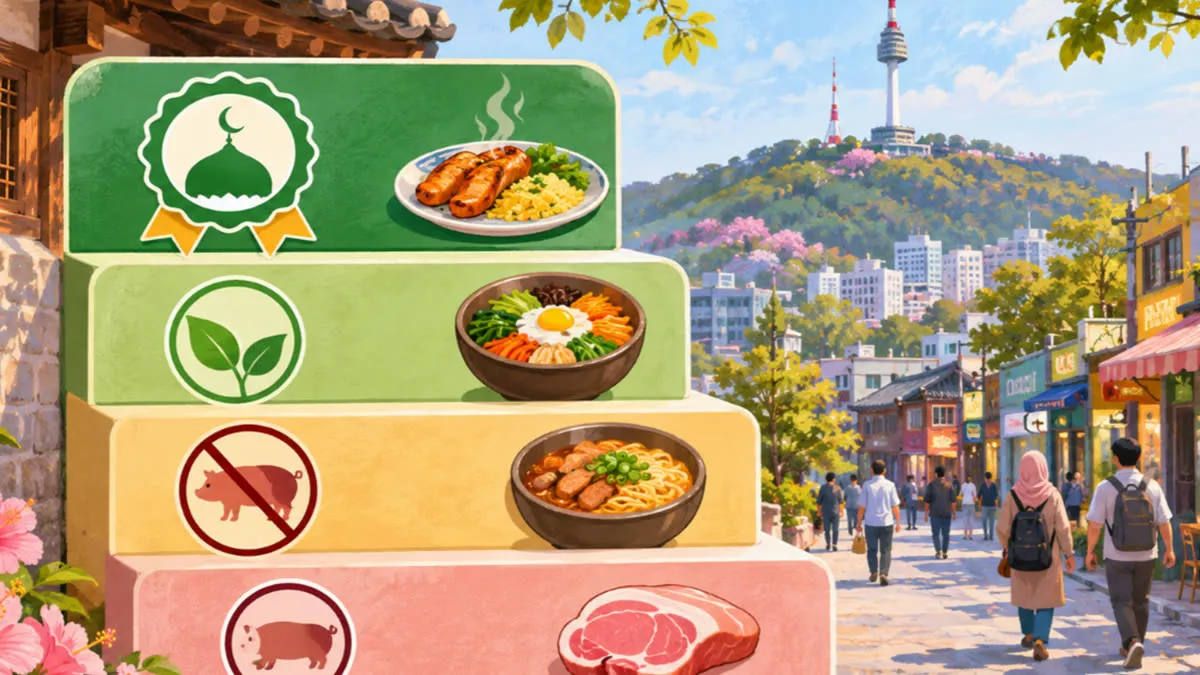
The Korea Tourism Organization (KTO) sorts Muslim-friendly places into four levels. Directories and apps use the same labels:
| Label | What it means | May serve alcohol? |
|---|---|---|
| Halal certified | KMF (or another body) has audited the kitchen | No |
| Self-certified | The owner says the food is halal; no outside audit | Not stated |
| Muslim-friendly | Some halal dishes, not the whole menu | Yes |
| Pork-free | No pork used, but no halal menu | Yes |
Some background on who certifies:
- KMF (한국이슬람교중앙회) was founded in 1967 and has certified halal food and restaurants since 1994. Its site is koreaislam.org (Korean, with an English menu). The site links to the certification pages but does not show a restaurant list on its homepage.
- HAI Korea (한국할랄진흥원) was authorized as an additional certification body by the agriculture ministry in December 2023. Its site is haikorea.org.
- KTO's restaurant data is old. According to Seoulstart, the VisitKorea portal's Muslim-friendly restaurant data dates from 2022. Treat a VisitKorea listing as a place to start looking, not as proof that a restaurant is still open or still at that level.
If a restaurant has a halal sign but no certificate on the wall, ask to see the certificate. If it has none, it is self-certified at best.
The mosque street in Itaewon
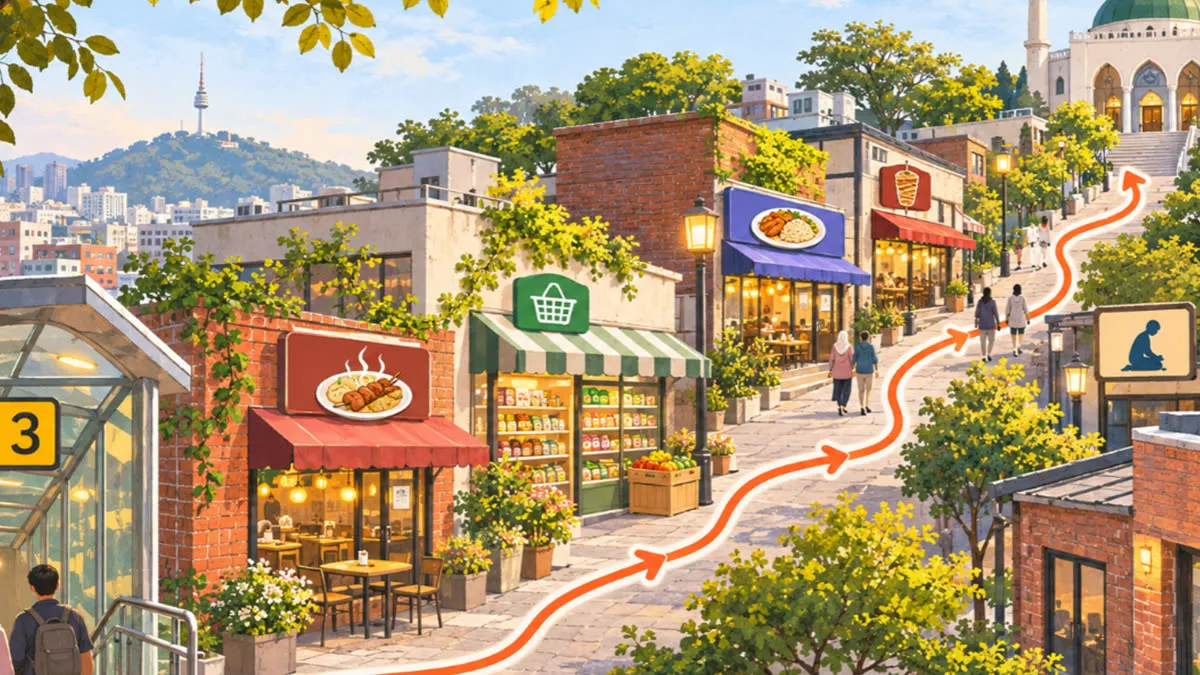
Getting there: Take Line 6 to Itaewon Station and leave by Exit 3. Walk straight along the main road to the crosswalk, turn right and go uphill. Where the street curves at the top of the hill, turn left to reach the mosque. The mosque is at 39 Usadan-ro 10-gil, Yongsan-gu (phone 02-794-7307). The lanes are steep and narrow, so walk from the station instead of taking a taxi to the door.
What's on the street: The roughly 200-meter stretch below the mosque is known as the Islamic street. It has Muslim-run restaurants (Turkish, Pakistani, Indian, Malaysian and Indonesian), halal butchers, Islamic bookshops and imported-food shops. Kervan's Itaewon branch is on Itaewon-ro at the bottom, and EID is on Usadan-ro 10-gil near the mosque. Most of the other restaurants are Muslim-owned but not certified, so ask which level applies.
Why it's here: The mosque opened on May 5, 1976, the first in Korea. The street grew after 1993, when a government industrial trainee scheme brought workers to Korea, many of them Muslims from Asian countries. Shops and restaurants opened to serve them.
Friday midday is the busiest time. More than 1,000 people attend Jumu'ah prayers, and in 2014 the Korea JoongAng Daily reported that not everyone could fit in the prayer hall. The street below is at its busiest then too. If you want a quiet meal, go on another day.
If you're not Muslim and want to see the mosque: go outside prayer times. Dress modestly, take your shoes off before entering prayer areas, and don't photograph people while they pray.
Halal groceries for residents
The shops on the mosque street sell halal beef, lamb and chicken, along with spices and imported packaged food. One shop with a listed address is Foreign Food Mart (포린푸드마트), 137-8 Itaewon 1-dong, Yongsan-gu, 02-793-0082 (foreignfoodkr.com). Seoulstart says it sells halal-certified products, but the store itself is not listed as certified.
Outside Seoul, the Wongok-dong multicultural market in Ansan, Gyeonggi-do (around Wongokgongwon-ro, Danwon-gu) has a cluster of halal meat shops. For delivery of packaged food, see Coupang and Baemin for Foreigners.
What to ask before ordering Korean food
Pork and alcohol show up in Korean cooking where you might not expect them:
- Broths: many soups, stews and ramen are made with pork bone stock (돼지 육수). Kimchi-jjigae is often cooked with pork.
- Marinades: galbi and bulgogi marinades often contain cooking wine (청주) or mirin (미림).
- Pastes: most gochujang and doenjang brands contain alcohol, which is why EID had to find halal versions.
- Kimchi: usually made with salted shrimp (새우젓) or other fermented seafood (젓갈). It contains no pork, but it isn't vegetarian.
- Sweets: gummies, marshmallows and some desserts contain gelatin (젤라틴). Look for 돼지 젤라틴 (pork gelatin) on the label.
- Instant noodles: flavor packets can contain meat extract. Read the ingredients at the convenience store.
Ask about specific ingredients, not just "halal". Staff may not know the word, and "yes" may only mean there's no pork in the main dish.
| English | Korean | Say it as |
|---|---|---|
| Is there pork in this? | 돼지고기 들어가요? | dwaeji-gogi deureogayo? |
| Is the broth made with pork? | 돼지 육수 들어가요? | dwaeji yuksu deureogayo? |
| Is there alcohol in this? | 술 들어가요? | sul deureogayo? |
| Do you have halal food? | 할랄 음식 있나요? | hallal eumsik innayo? |
| Please leave out the meat. | 고기 빼 주세요. | gogi ppae juseyo |
If you're away from Itaewon, seafood and vegetable dishes are your best bet. Haemul pajeon (seafood pancake), grilled fish and vegetable bibimbap are good choices, but ask about the broth and the sauce. Our vegetarian food in Seoul guide lists dishes that are meat-free by default. For more phrases, see Korean phrases for travelers.
Where to pray outside the mosque
- Seoul Central Mosque, Itaewon: holds about 1,500 people across three floors. The women's prayer area is on the third floor.
- COEX, Gangnam: the prayer room (musalla) is on the 3rd floor of the COEX Convention Center, 513 Yeongdong-daero, Gangnam-gu. The Korea International Trade Association opened it in January 2016 with separate rooms for men and women. It provides Qurans, prayer mats and a qibla compass. When it opened, the hours were 3 a.m. to 10 p.m. daily. Check the current hours before you go early or late. The Kervan COEX branch is in the mall's B1 level.
- Incheon International Airport: Seoulstart lists multi-faith prayer rooms in Terminal 1 (3F near Gate 24, and 4F in the West Transfer Lounge) and in Terminal 2 (3F near Gates 231 and 268, and 4F Concourse East), open 24 hours. The gate-area rooms are past security, so you need a boarding pass. If you have a long wait between flights, see our Seoul layover guide.
- Lotte World: has a prayer room with separate spaces for men and women. Ask at guest services for the location.
To find others, use the MUFKO (Muslim Friendly Korea) app for iOS and Android. It maps more than 180 prayer rooms and mosques and has a scanner for Korean food labels. Its listings can be out of date, so call ahead when it matters. For walking directions, use Naver Map or Kakao Map. Google Maps directions are limited in Korea, as our best map app for Korea guide explains.
If you're leaving Seoul for the day
Halal restaurants are much harder to find outside Seoul. Pack snacks whose labels you've already checked. Before you travel, search the MUFKO app or the Seoulstart directory for your destination. The directory also lists mosques in Ansan, Incheon, Busan, Daegu, Daejeon, Jeonju, Gwangju and Gimhae.
Sources
Last checked: — Prices, hours and rules in Korea change often; check the official pages below before you go.
- Seoulstart – Halal and Muslim-friendly directory
- Seoulstart – Finding halal food in Korea
- Korea JoongAng Daily – Where the mosque is a focal point
- Korea Herald – Itaewon, where Korea meets the Islamic world
- Korea Herald – Restaurant puts halal touch on Korean cuisine (EID)
- Korea Times – COEX opens Muslim prayer rooms
- Korea Muslim Federation
Facts were checked against the sources above, and the article was written by Seoul Sidekick with the help of AI tools. Report an error