Korean Phrases for Travelers: 30 Everyday Lines and How to Say Them
30 Korean phrases for travelers in Hangul, romanization and plain-English sound-outs: greetings, ordering food, paying, taxis, prices and emergencies.
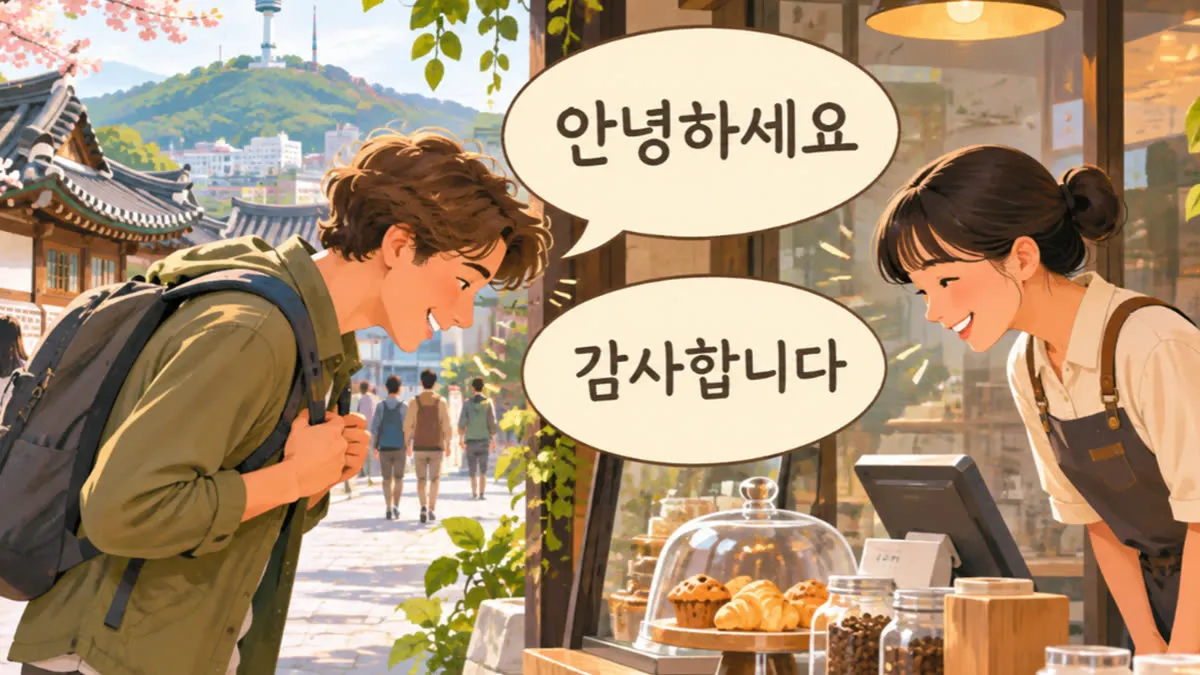
Five phrases cover most of a trip: annyeonghaseyo (hello), gamsahamnida (thank you), jeogiyo (excuse me, to call staff), igeo juseyo (this one, please) and eolmayeyo? (how much is it?). If people don't understand you, show them the Hangul column on your phone. A Korean reader understands it even when your pronunciation is off.
Each phrase below is written three ways: in Hangul, in the official romanization you see on road signs and subway maps, and as an English-style sound-out.
Five romanization sounds that differ from English
Korea's road signs, station names and most menus use the Revised Romanization set by the National Institute of Korean Language. Its rules say it is 'based on standard Korean pronunciation', so it spells words the way they are said, not letter by letter from Hangul. These are the spellings that cause the most mistakes:
- eo (ㅓ) sounds like the u in 'cup', not 'ee-oh'. Seoul is closer to 'Suh-ool', and eolmayeyo starts with 'uhl'.
- eu (ㅡ) is a short 'uh' with flat, unrounded lips.
- ae (ㅐ) and e (ㅔ) both sound roughly like the e in 'bed' for most speakers today.
- g, d, b and k, t, p: ㄱ, ㄷ, ㅂ are written g, d, b before a vowel and k, t, p before another consonant or at the end of a word. To English ears they fall between the two, so gamsahamnida can sound like 'kahm-sa-ham-ni-da'.
- r and l are the same letter, ㄹ. It is written r before a vowel and l before a consonant or at the end of a word (Seorak, Chilgok).
Sounds also change when letters meet, and the romanization follows the sound. The institute's own example is 왕십리, said 'wang-sim-ni' and written Wangsimni. The same change turns the ㅂ in 감사합니다 into an 'm' sound, giving gamsahamnida. So read the romanization, not the Hangul letters one by one. Korean has very little word stress, so give every syllable the same weight.
Politeness: phrases ending in -yo (요) are polite with anyone. Phrases ending in -mnida (니다) are more formal; it is how staff speak to customers. Keep these endings with strangers. Shortened forms such as gomawo (thanks) are only for close friends.
Greetings and getting help: phrases 1–10
| # | English | Hangul | Romanization | Say it like |
|---|---|---|---|---|
| 1 | Hello | 안녕하세요 | annyeonghaseyo | ahn-nyung-ha-say-yo |
| 2 | Thank you | 감사합니다 | gamsahamnida | kahm-sa-ham-nee-da |
| 3 | Yes / No | 네 / 아니요 | ne / aniyo | neh / ah-nee-yo |
| 4 | I'm sorry | 죄송합니다 | joesonghamnida | chweh-song-ham-nee-da |
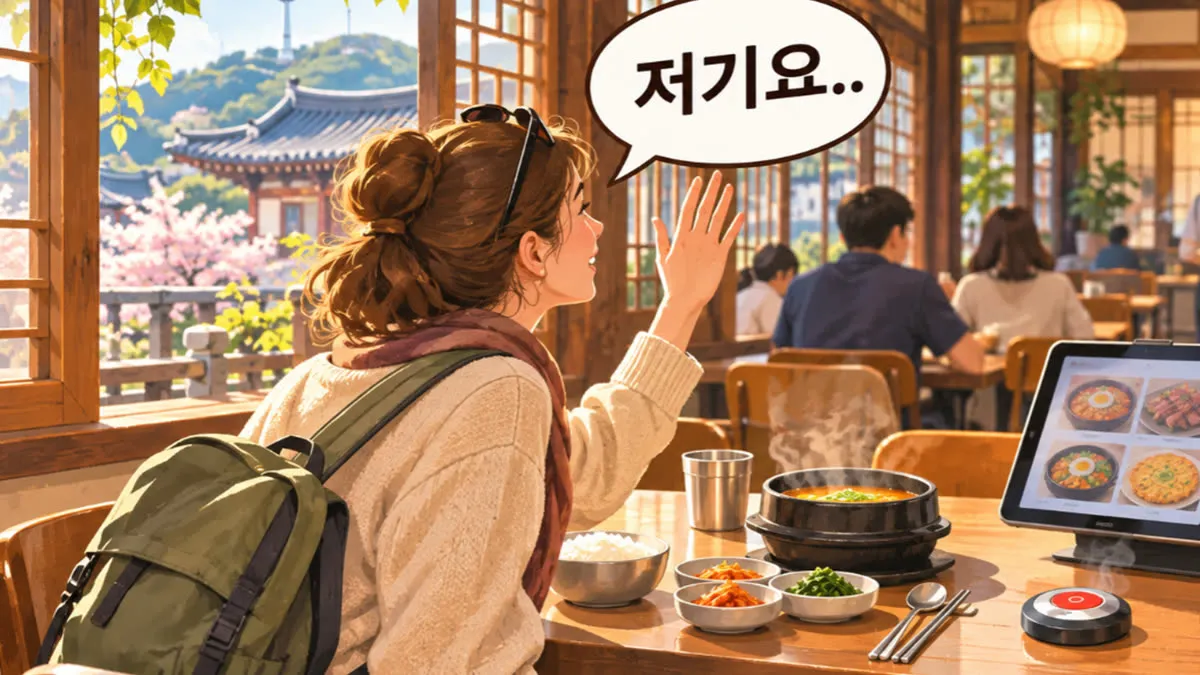
| 5 | Excuse me (to get attention) | 저기요 | jeogiyo | juh-gee-yo |
| 6 | It's okay / I'm fine / No thanks | 괜찮아요 | gwaenchanayo | gwen-cha-na-yo |
| 7 | Goodbye (to someone leaving) | 안녕히 가세요 | annyeonghi gaseyo | ahn-nyung-hee ga-say-yo |
| 8 | I don't speak Korean well | 한국어 잘 못해요 | hangugeo jal motaeyo | han-goo-guh jal mo-teh-yo |
| 9 | Do you speak English? | 영어 하세요? | yeongeo haseyo? | yung-uh ha-say-yo? |
| 10 | Please speak slowly | 천천히 말해 주세요 | cheoncheonhi malhae juseyo | chun-chun-hee mal-heh joo-say-yo |
- Annyeonghaseyo works at any time of day. Most people say it with a small nod.
- Gwaenchanayo has several uses. It turns down a bag or an offer of help, and it tells someone who bumped into you that you're fine.
- Korean has two goodbyes. To someone who is leaving, say annyeonghi gaseyo ('go in peace'). When you are the one leaving, for example walking out of a shop, say annyeonghi gyeseyo (안녕히 계세요, 'stay in peace').
- 'Excuse me' depends on the situation. To call a server, say jeogiyo. To get past someone or apologize, say joesonghamnida. To interrupt someone, say sillyehamnida (실례합니다).
- Gamsahamnida is the safe thank-you with staff, drivers and older people. Gomawoyo (고마워요) is polite but warmer, and fine with people your own age once you're chatting.
Ordering at restaurants and cafes: phrases 11–18
You call staff over in Korea; they won't stop by on their own. Say jeogiyo! clearly, or press the call button if the table has one.
| # | English | Hangul | Romanization | Say it like |
|---|---|---|---|---|
| 11 | This one, please (while pointing) | 이거 주세요 | igeo juseyo | ee-guh joo-say-yo |
| 12 | There are two of us | 두 명이에요 | du myeongieyo | doo myung-ee-eh-yo |
| 13 | Menu, please | 메뉴판 주세요 | menyupan juseyo | meh-nyoo-pan joo-say-yo |
| 14 | Water, please | 물 주세요 | mul juseyo | mool joo-say-yo |
| 15 | Not spicy, please | 안 맵게 해 주세요 | an maepge hae juseyo | ahn mep-geh heh joo-say-yo |
| 16 | To go, please | 포장해 주세요 | pojanghae juseyo | po-jang-heh joo-say-yo |
| 17 | The bill, please | 계산해 주세요 | gyesanhae juseyo | gyeh-san-heh joo-say-yo |
| 18 | It's delicious | 맛있어요 | masisseoyo | ma-shee-suh-yo |
Juseyo (주세요) means 'please give me'. Put a noun in front of it and you have a polite request: keopi juseyo (coffee, please), hana juseyo (one, please). It is the most useful word on this page.
Staff usually ask how many are in your group at the door, and phrase 12 answers that. Head counts use native Korean numbers: han myeong (one person), du myeong (two), se myeong (three), ne myeong (four). Holding up fingers also works.
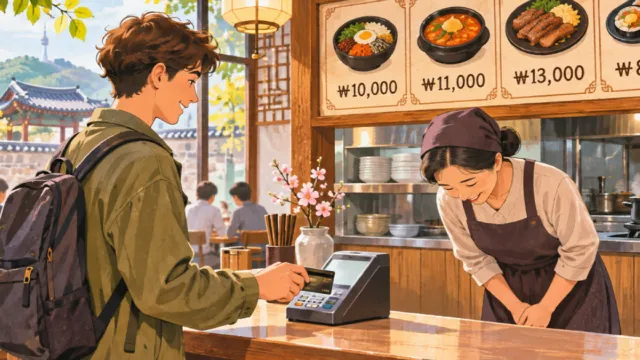
In many restaurants you pay at the counter by the door on your way out, so say phrase 17 there. You don't need to add a tip; see tipping in Korea for the few exceptions. If you don't eat meat or fish, our vegetarian food in Seoul guide has the longer phrases you need.
Asking the price and paying in shops: phrases 19–23
| # | English | Hangul | Romanization | Say it like |
|---|---|---|---|---|
| 19 | How much is it? | 얼마예요? | eolmayeyo? | uhl-ma-yeh-yo? |
| 20 | Can I pay by card? | 카드 돼요? | kadeu dwaeyo? | ka-duh dweh-yo? |
| 21 | A bag, please | 봉투 주세요 | bongtu juseyo | bong-too joo-say-yo |
| 22 | Receipt, please | 영수증 주세요 | yeongsujeung juseyo | yung-soo-jeung joo-say-yo |
| 23 | I'm just looking | 그냥 볼게요 | geunyang bolgeyo | geu-nyang bol-geh-yo |
Two questions you will hear at the till:
- Bongtu piryohaseyo? ('Do you need a bag?'). Answer ne for yes or gwaenchanayo for no.
- Yeongsujeung deuryeoyo? ('Shall I give you the receipt?'). Same answers.
If a clerk follows you around the shop, geunyang bolgeyo tells them you're only looking.
Hearing prices: count in ten-thousands
Prices use Sino-Korean numbers (il, i, sam: one, two, three), and they are grouped by ten thousand, not by thousand. Sino-Korean numbers are also used for phone numbers, floors and minutes. The native numbers (hana, dul, set) are for counting people and things.
| Amount | Korean | Say it like |
|---|---|---|
| 1,000 won | 천 원 (cheon won) | chun won |
| 4,800 won | 사천팔백 원 (sacheon-palbaek won) | sa-chun-pal-bek won |
| 10,000 won | 만 원 (man won) | mahn won |
| 15,000 won | 만오천 원 (man-ocheon won) | mahn-oh-chun won |
| 50,000 won | 오만 원 (oman won) | oh-mahn won |
The word to listen for is man (만, 10,000). Thirty thousand won is sam-man won, literally 'three ten-thousands'. If you miss the number, ask the cashier to show you the card terminal or a calculator.
Taxis and directions: phrases 24–28
| # | English | Hangul | Romanization | Say it like |
|---|---|---|---|---|
| 24 | Where is ___? | ___ 어디예요? | ___ eodiyeyo? | ___ uh-dee-yeh-yo? |
| 25 | Where is the restroom? | 화장실 어디예요? | hwajangsil eodiyeyo? | hwa-jang-shil uh-dee-yeh-yo? |
| 26 | Please take me to ___ | ___ 가 주세요 | ___ ga juseyo | ___ ga joo-say-yo |
| 27 | Please stop here | 여기서 세워 주세요 | yeogiseo sewo juseyo | yuh-gee-suh seh-wo joo-say-yo |
| 28 | Does this bus go to ___? | 이 버스 ___ 가요? | i beoseu ___ gayo? | ee buh-seu ___ ga-yo? |
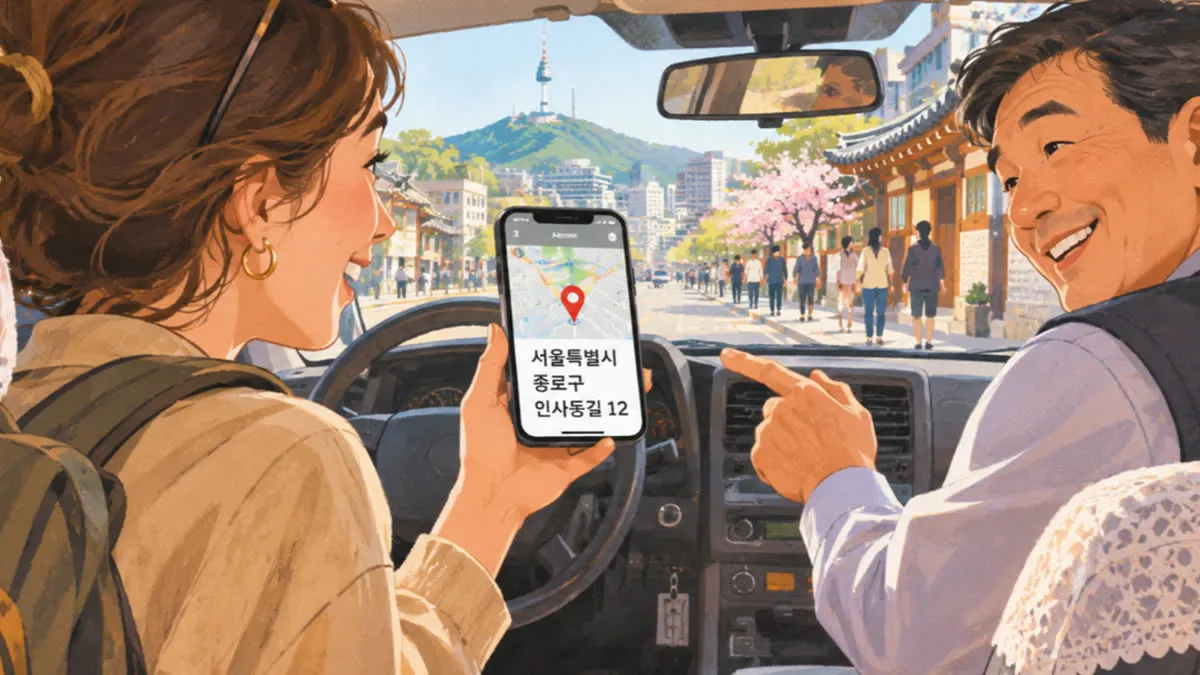
For phrase 26, the place name alone is usually enough: Myeongdong-yeok ga juseyo (Myeongdong Station, please). Drivers recognize Korean place names faster than English ones. The most reliable way is to show the Hangul address on your map app. Best map app for Korea shows how to copy a Korean address in Naver Map or Kakao Map.
The meter sets the fare, so there is nothing to bargain over. These are the Seoul city government's fares for a standard (mid-size) taxi. They have applied since February 1, 2023, and we checked the city's fare page on November 19, 2026:
| Time | Base fare (first 1.6 km) | Then |
|---|---|---|
| 04:00–22:00 | 4,800 won | 100 won per 131 m or per 30 seconds |
| 22:00–23:00 and 02:00–04:00 (+20%) | 5,800 won | 120 won per 131 m or per 30 seconds |
| 23:00–02:00 (+40%) | 6,700 won | 140 won per 131 m or per 30 seconds |
The time charge applies when the taxi moves slower than 15.72 km/h. Rides from Incheon Airport into Seoul use a separate fixed-fare table. See the Seoul taxi guide for Kakao T and card payment.
In an emergency: phrases 29–30
| # | English | Hangul | Romanization | Say it like |
|---|---|---|---|---|
| 29 | Help! | 도와주세요! | dowajuseyo! | doh-wa-joo-say-yo! |
| 30 | I need to go to a hospital | 병원에 가야 해요 | byeongwone gaya haeyo | byung-won-eh ga-ya heh-yo |
Two more useful words: apayo (아파요, 'it hurts' or 'I'm sick') and gyeongchal (경찰, police). Dial 112 for police and 119 for fire or an ambulance.
For non-urgent help, such as a lost bag, a dispute with a shop or a phrase you can't get across, call the 1330 Korea Travel Helpline, run by the Korea Tourism Organization. Dial 1330 inside Korea, with no area code, or +82-2-1330 from abroad. According to Hanam City's 1330 page, the line:
- answers in Korean, English, Chinese, Japanese, Russian, Vietnamese, Thai, Malay and Indonesian, and can connect you to the Tourist Police;
- offers text chat in Korean, English, Japanese and Chinese through its own messenger, KakaoTalk, Facebook Messenger and LINE;
- charges no extra fee.
Published sources give different hours. Hanam City lists 24-hour service, with Vietnamese, Thai, Malay and Indonesian by phone only from 08:00 to 19:00. A March 2026 Korea Times article said 7 a.m. to midnight. If you need the line at night or in a less common language, check the 1330 page on VisitKorea (english.visitkorea.or.kr) first. More numbers are in emergency numbers in Korea.
Mistakes that make you harder to understand
- Reading romanization as English spelling. 'Eo' and 'eu' cause most of the trouble (see the sound list above).
- Sounding out Hangul letter by letter. 감사합니다 is said with an 'm', and 맛있어요 comes out as 'ma-shee-suh-yo'. Follow the 'Say it like' column.
- Dropping the -yo. Juseyo, eodiyeyo and gwaenchanayo sound polite. Cut off the ending and you sound abrupt.
- Calling staff agassi (miss) or ajumma (ma'am). Both can sound rude. Jeogiyo is always safe. You may hear regulars say imo ('auntie') or sajangnim ('boss') in small restaurants, but you don't need to.
- Beckoning with the palm up. To call someone over, Koreans usually wave with the palm facing down. Curling a finger toward yourself, palm up, is seen as rude.
If you get stuck mid-sentence, type the English into Papago and show the screen, or start with annyeonghaseyo and yeongeo haseyo? before switching to simple English.
Sources
Last checked: — Prices, hours and rules in Korea change often; check the official pages below before you go.
- National Institute of Korean Language – Romanization of Korean
- Seoul Metropolitan Government – Seoul Taxi Fares (서울 택시요금)
- Hanam City – Tourist Interpretation 1330
- Busan Metropolitan City – 1330 Korea Travel Hotline (2019 notice)
- The Korea Times – Sick in Korea after hours? (March 14, 2026)
Facts were checked against the sources above, and the article was written by Seoul Sidekick with the help of AI tools. Report an error