Tipping in Korea: Why You Don't Tip and the Few Real Exceptions
No tipping in Korea: menu prices must include VAT and service by law. What to do at restaurants, taxis, hotels and tours, and when a tip makes sense.
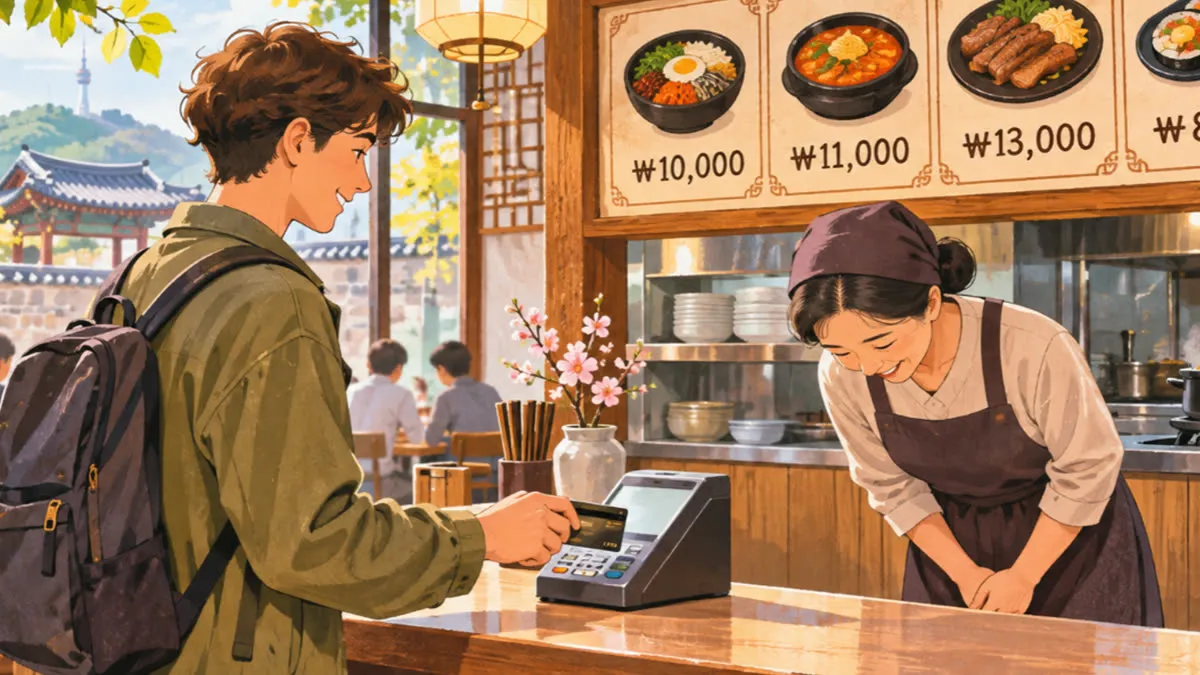
No. You don't tip in Korea at restaurants, cafes, bars, taxis or guesthouses. By law, restaurant and coffee-shop menus must show the final price with VAT and any service charge already in it, so the menu price is what the card machine charges. Read the small print on hotel bills. A cash thank-you is only common with private tour guides and drivers.
Restaurants, taxis, hotels, tours: tip or not
| Where | Tip? | What you pay |
|---|---|---|
| Restaurants, BBQ, street food, pocha | No | The menu price, usually at the counter or a kiosk |
| Cafes and bakeries | No | The listed price |
| Taxis | No | The meter fare. Rounding up is your choice |
| Kakao T tip screen, if it appears | Optional | Close it, or pick 1,000, 1,500 or 2,000 won |
| Hotels | No separate tip | Check whether the rate includes tax and service charge |
| Guesthouses, motels, hanok stays | No | The booked price |
| Private tour guide or driver | Optional | Cash, if you were happy with the day |
Koreans say thank you in words instead: gamsahamnida (thank you), or jal meogeosseumnida (I ate well) as you leave a restaurant. Our Korean phrases guide has more lines like these. For ordering and paying at a grill restaurant, see our Korean BBQ etiquette guide.
Most Koreans want to keep things this way. The Korea Times reported in August 2023 on an SK Communications survey of 12,106 people: more than seven in ten said tipping was unacceptable, 19% called it a personal choice and only 5% supported it. Segye Ilbo put the share opposed at 73%.
Why the menu price is already the final price
Revised enforcement rules under the Food Sanitation Act took effect on January 1, 2013. They require general restaurants and coffee shops to show only the final price the customer pays. Lines such as 'VAT 10% separate' or 'service charge not included' had to go. The government's example from that time: a Korean set course listed at 30,000 won, with '10% service, 10% VAT separate' printed below, now has to be listed at 36,000 won.
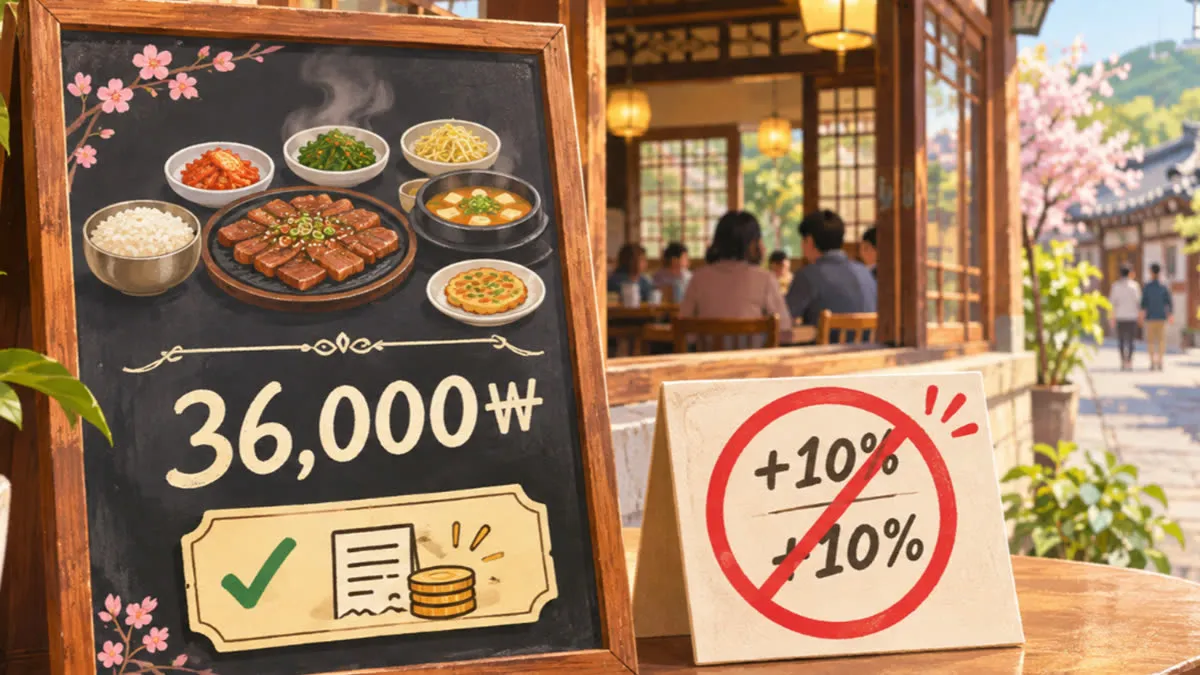
The Ministry of Food and Drug Safety told the Korea Times in 2023 that forcing a customer to pay more than the listed price breaks the Food Sanitation Act.
The penalties are now heavier. On September 1, 2026 the ministry promulgated revised enforcement rules for food service businesses, such as restaurants and cafes, that charge more than their posted price or post no prices at all:
| Offence | Before | After the September 2026 revision |
|---|---|---|
| First | Correction order | 5-day business suspension |
| Second | 7-day suspension | 10-day suspension |
| Third | 15-day suspension | 20-day suspension |
Lodging got similar first-offence suspensions earlier in 2026. General and residential lodging came first in July, then hanok experience stays and foreign-tourist urban homestays in August.
If a kiosk, tip box or app asks for a tip
You can skip it. Under the Food Sanitation Act, a restaurant breaks the law when it forces a separate charge on you. Offering an optional tip is legal. That is how Segye Ilbo explained the rule in July 2025, after two cases made national news. On July 21, 2025, a Seoul naengmyeon (cold noodle) restaurant was found to have a kiosk option that added 300 won as a 'staff dinner fee'. Around the same time, a restaurant in Yeouido put a 'TIPBOX' on its counter. Both drew heavy criticism online.
If you are charged more than the menu or price board shows, point to the posted price. If that doesn't settle it, call 1330, the Korea Tourism Organization's travel helpline. For other numbers to keep on your phone, see emergency numbers in Korea.
Taxis and the Kakao T thank-you tip
Pay the fare on the meter. Drivers don't expect a tip. Our Seoul taxi guide explains how to pay and how late-night fares work.
You might still see a tip screen in Kakao T. In mid-July 2023, Kakao Mobility began a trial of an optional thank-you tip in the app. The screen appears only after you give the driver 5 stars, and it offers 1,000, 1,500 or 2,000 won. Kakao said the driver gets the tip minus minimal costs such as payment fees. People did not like it. In an Opensurvey poll of 1,000 people in their 20s to 50s, 71.7% were against it and 17.2% were in favor. We could not confirm whether the screen still appears in 2026. If it does, you can close it without tipping.
How to check a hotel rate for a service charge
Korean tourist hotels can add a service charge to the bill. The Korea Culture and Tourism Institute published a report on these charges in February 2025, Analysis of Service Charges at Tourist Hotels and Implications. When you book:
- Before you pay, look at the final total, not the headline nightly rate.
- Look for wording that says whether tax and service charge are included or excluded.
- Compare hotels by their final totals.
If a service charge is on your bill, it already pays for service. You don't need to tip housekeeping, bell staff or the concierge separately. Guesthouses, motels and hanok stays don't add service charges or expect tips.
When a cash thank-you makes sense: private guides and drivers
Private or small-group tours for foreign visitors are the main exception. There is no official standard amount, and a tip is never required. If the tour company's booking terms say anything about gratuities, follow them. Otherwise, a modest cash thank-you at the end of a good day is a kind gesture.

If you give one:
- Hand it over in person at the end. Don't leave money on a seat or table.
- Use both hands, which is the polite way to hand anything to someone in Korea.
- Put the cash in an envelope so it reads as a gift, not a payment.
- Say what it's for: 'Thank you, this is for you.'
- If the person refuses twice, take it back and thank them again.
For people who help you outside a paid service, such as a neighbor, a landlord or movers on a hot day, Koreans usually thank them with drinks, snacks or a small gift rather than cash.
Sources
Last checked: — Prices, hours and rules in Korea change often; check the official pages below before you go.
- Korea Policy Briefing (korea.kr) – Menus to show final price only, VAT and service included (January 11, 2013)
- Segye Ilbo – Tip controversy: Yeouido TIPBOX and 300-won kiosk option (July 30, 2025)
- The Sisa Law – MFDS revises Food Sanitation Act enforcement rules: 5-day suspension for first price violation (September 1, 2026)
- Korea Times – Koreans uncomfortable with emergence of tipping culture (August 25, 2023)
- inews24 – Kakao T thank-you tip trial and Opensurvey results (August 21, 2023)
- Korea Culture and Tourism Institute – Analysis of Service Charges at Tourist Hotels and Implications (February 15, 2025)
Facts were checked against the sources above, and the article was written by Seoul Sidekick with the help of AI tools. Report an error