What to Pack for Korea: Season-by-Season Packing List and Tips
What to pack for Korea by month, based on Seoul's official climate averages: winter coats and thermals, rainy-season gear, plug adapter and power bank rules.
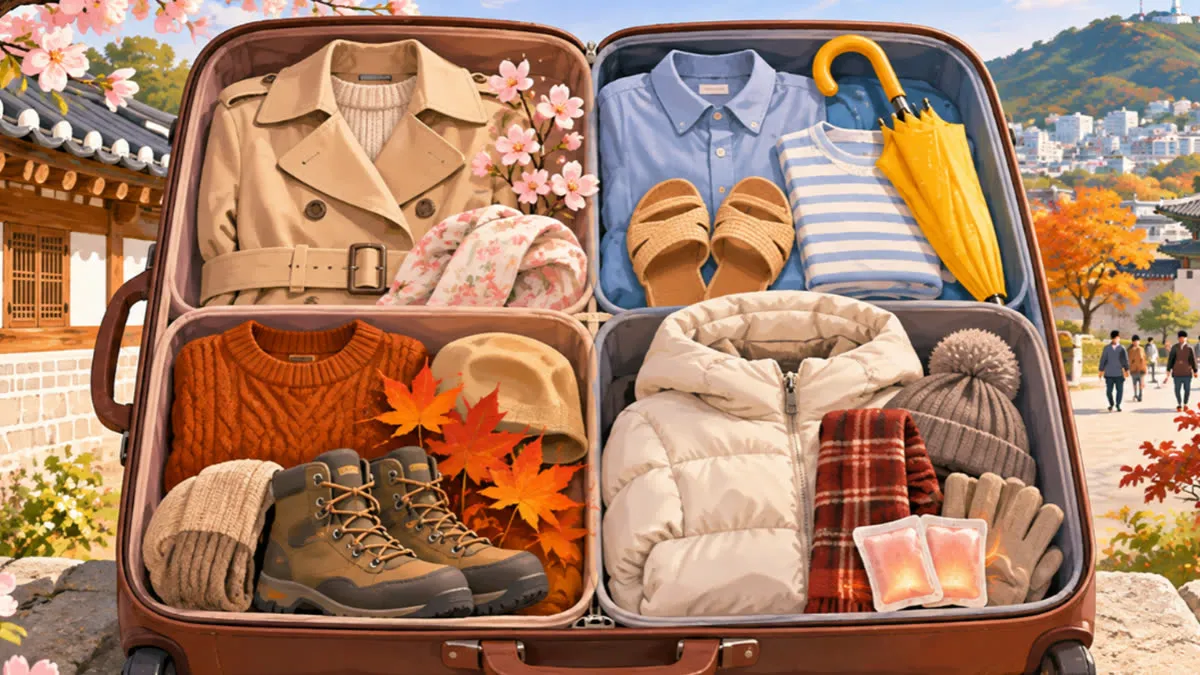
Pack for the month, not for "Korea". Seoul averages −1.9°C (28.6°F) in January and 26.1°C (79°F) in August. July brings 414.4 mm of rain, about 25 times January's 16.8 mm. In winter you need a long padded coat and thermals. In July and August you need quick-dry clothes and shoes that can get soaked. In spring and autumn you need layers.
The weather figures below are the Korea Meteorological Administration's (KMA) 1991–2020 averages for Seoul. Prices, plug details and airline power bank rules are as of November 19, 2026.
What to bring, month by month
| When | Seoul weather (KMA averages) | Bring |
|---|---|---|
| December–February | Coldest month is January, mean −1.9°C. Winter gets only about 5% of the year's precipitation (67.6 mm in total) | Knee-length padded coat, thermal top and leggings, hat, scarf, gloves, boots with grip, heavy moisturizer |
| March–May | Driest air in February and March (54.6% humidity). Windiest months are March and April | Windproof jacket, light knit, a packable fleece or down vest, lip balm, a mask for fine-dust days |
| June–August | About 63% of the year's rain falls in these three months. July is the most humid month (76.2%) and August the hottest | Quick-dry clothes, sandals or quick-dry shoes, a compact umbrella, one light long-sleeve layer for the air conditioning |
| September–November | First frost around October 28, first ice around November 3, first snow around November 20 | September: summer clothes plus a light jacket. October: jeans, knits, a mid-weight jacket. November: a winter coat, scarf and light gloves |
These are monthly means. They hide cold January nights with wind and very hot August afternoons, so pack for the colder or hotter end. For crowds and festivals by month, see best time to visit Korea.
Bring these in any month
- Shoes that are already broken in and slip on easily. You will climb subway stairs and walk long station corridors. Many restaurants with floor seating, guesthouses and temples ask you to take your shoes off, so lace-up boots soon get tiresome.
- Socks without holes. People will see them every time your shoes come off.
- A plug adapter for two round pins. Korea uses Type C and Type F plugs at 60 Hz. The supply is usually given as 220V; the reference site we checked lists 230V. A charger labelled 100–240V works with just an adapter. A hair dryer or straightener rated only for 110V needs a voltage converter, or it should stay at home. Our plug type and voltage guide has more detail.
- A power bank, in your cabin bag. Asiana's rules, which most airlines share: power banks are not allowed in checked bags. You may carry two power banks of 100 Wh or less. Power banks between 100 and 160 Wh need airline approval and are limited to two. Anything over 160 Wh is prohibited. On board you cannot use or charge a power bank, and you must not put it in the overhead bin. Tape over the terminals or put each one in its own clear zip bag, and keep it on you. A power bank whose capacity is not printed on it can be refused. Rules differ by airline, so check your own carrier's restricted-items page before you fly in and before you fly home.
- Prescription medicine in its original packaging. Korean pharmacies stock common medicines, but under different brand names.
- A compact umbrella, except in deep winter.
Spring (March to May): wind, dry air and fine dust
Early March still feels like winter, and by late May afternoons are close to summer. On a typical day you will want a T-shirt, a light knit and a windproof jacket or trench coat. In March, add a warmer coat. A fleece or thin down vest that folds into your bag is enough for evenings by the river.
The air is dry and windy, so bring lip balm and moisturizer. If pollen bothers you, bring your own allergy medicine.
Fine dust is the spring problem the weather forecast won't warn you about. Check AirKorea (airkorea.or.kr/eng), the national air quality site run by the Ministry of Environment and the Korea Environment Corporation. Its index rates 0–50 as Good, 51–100 Moderate, 101–250 Unhealthy and 251–500 Very Unhealthy. On Unhealthy days, wear a KF94 mask. Convenience stores and pharmacies sell them, so you don't need to pack any.
Summer (June to August): jangma rain, then heat
The rainy season is called jangma (장마). By KMA's normal dates, it runs in the Seoul region from about June 25 to July 26, in the south from June 23 to July 24, and on Jeju from June 19 to July 20. Actual dates differ every year. In 2026, KMA's provisional analysis put the start in the central region on July 1, six days late. KMA publishes the official dates only after its summer analysis in early September. Heavy rain and humid heat continue into August.
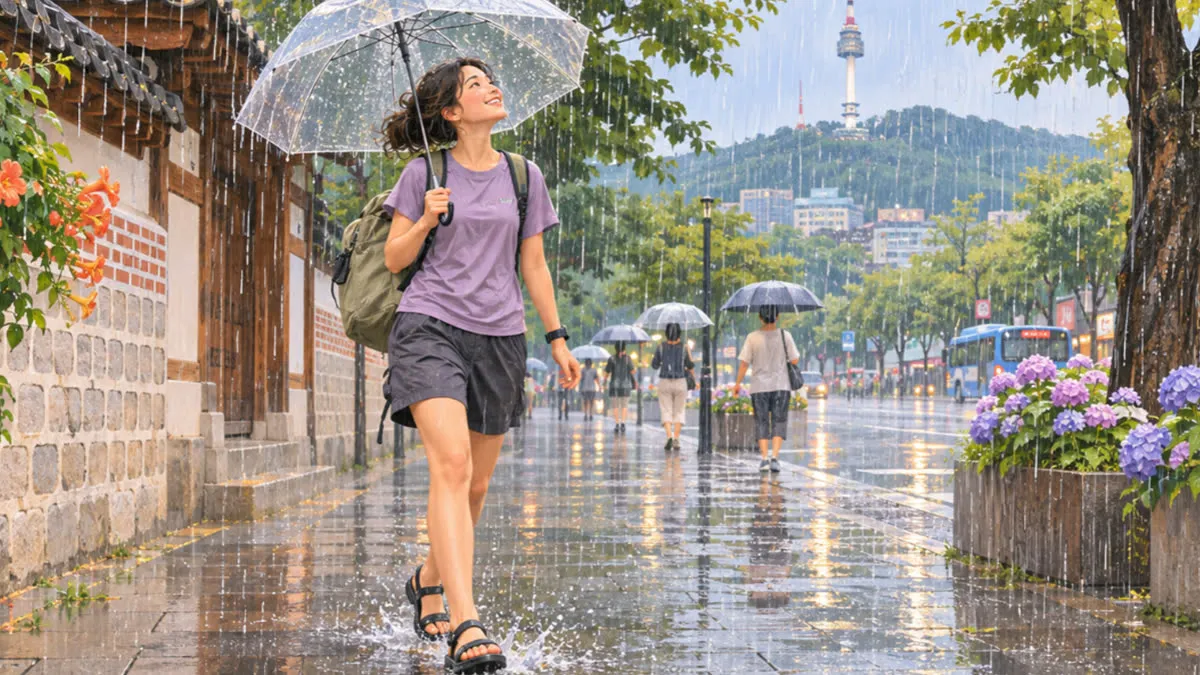
- Two pairs of shoes. If one pair soaks through in a downpour, it may not dry overnight in July humidity. Sandals or quick-dry trainers are better in the rain than leather.
- Quick-dry or linen tops, more than you think you need.
- An umbrella, not a heavy raincoat. A raincoat is too hot in this humidity.
- One light long-sleeve layer for cold subway cars, cafés and cinemas.
- Sunscreen, sunglasses and a cap. Korean sunscreen is sold in every drugstore (see our Olive Young guide), so you can buy it after you land.
- Mosquito repellent for evenings in parks and along the Han River.
If rain ruins an outdoor day, see rainy day in Seoul.
Autumn (September to November): dress for a 10-degree swing
September afternoons can still feel like summer. By November, Seoul has had its first frost (normally around October 28) and its first ice (around November 3), and the first snow normally falls around November 20. Treat November as early winter: bring a warm coat, a scarf and light gloves. That goes double for mountains and the east coast.
In October, pack proper trail shoes if you plan a hike such as Bukhansan. Trainers slip on granite. As the air cools it dries out, so bring lip balm again.
Winter (December to February): one big coat, thin layers underneath
Winter is cold, dry and windy. Snow does fall, but winter gets only about 5% of Seoul's yearly precipitation, so it is usually light. Gangwon Province's mountains and ski areas are noticeably colder than central Seoul. For where to see snow this year, see Korea first snow 2026.
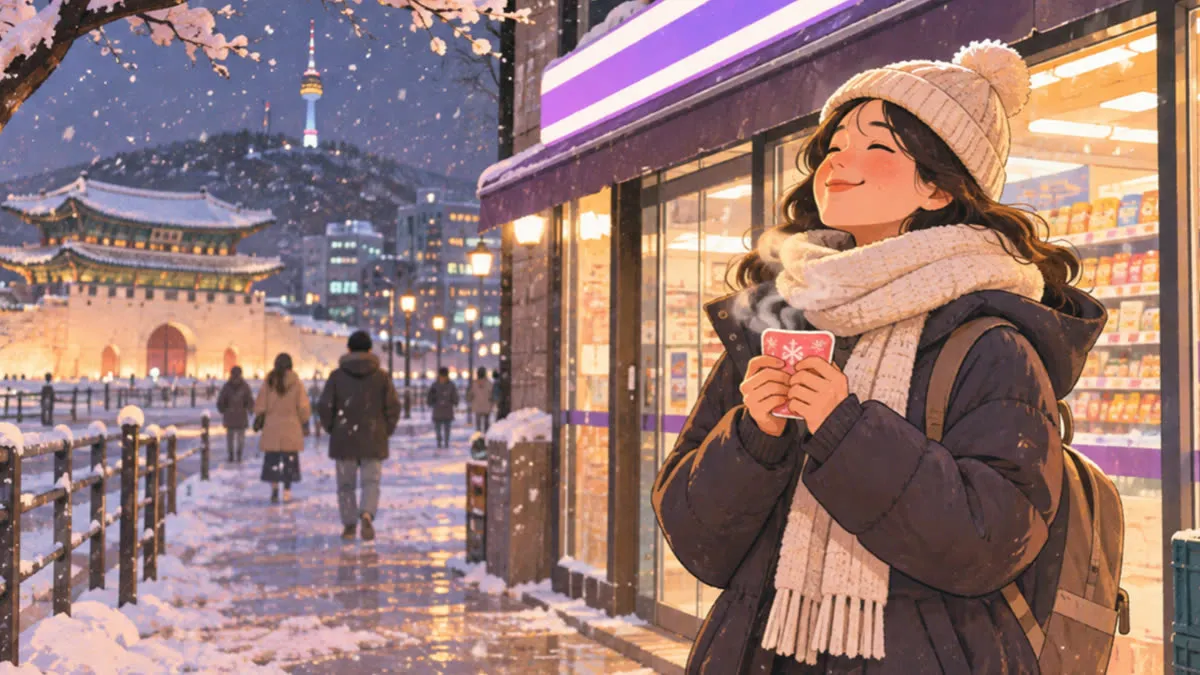
- A knee-length padded or down coat. This is the main thing that keeps you warm outdoors.
- Thermal top and leggings instead of thick sweaters. Subway cars, shops and cafés are heated. If you wear a heavy sweater, you end up carrying it around. A coat over a thin thermal layer comes off in one move.
- A hat, a scarf or neck warmer, and touchscreen gloves, because you will use your map app outdoors.
- Boots with a grippy sole for icy stairs and sidewalks after snow.
- Heavy moisturizer, hand cream and lip balm. Indoor heating and outdoor wind dry your skin out quickly.
Don't pack hand warmers (핫팩, hat-paek). Convenience stores sell them. GS25 listed a pocket hand warmer at ₩1,500 (about US$1) in its February and April 2026 2+1 promotions.
What to leave at home and buy in Seoul
Everyday items are easy to find, so you can pack light and leave room for shopping. Our Korean convenience stores guide explains what the 24-hour chains stock.
| Item | Where to buy it |
|---|---|
| Hand warmers | Convenience stores (GS25: ₩1,500 each, 2+1 deals in 2026) |
| Umbrella | Convenience stores, Daiso |
| KF94 masks | Convenience stores, pharmacies |
| Sunscreen and skincare | Olive Young, pharmacies |
| Socks and thermal wear | Daiso, budget clothing chains, markets |
If you plan to shop, pack a foldable bag for the extra things on the flight home.
Check the forecast each morning
Monthly averages only help with packing. Each day, check the hourly forecast on KMA's site (weather.go.kr) or in a Korean weather app. On spring days, also check AirKorea before you decide on a mask.
Sources
Last checked: — Prices, hours and rules in Korea change often; check the official pages below before you go.
- Korea Meteorological Administration – Seoul and Gyeonggi regional climate (1991–2020 normals)
- Vegan News – Normal rainy season (jangma) start and end dates by region, citing KMA (July 10, 2026)
- AirKorea – Ministry of Environment / Korea Environment Corporation national air quality information
- Pyony – GS25 pocket hand warmer price and 2+1 promotion record (2026)
- Asiana Airlines – Restricted items (lithium batteries and power banks)
- WorldStandards – South Korea plug types, voltage and frequency (updated July 12, 2025)
Facts were checked against the sources above, and the article was written by Seoul Sidekick with the help of AI tools. Report an error