Korean Convenience Stores: How They Work, What to Buy and Prices
Korean convenience stores: paying with foreign cards, T-money top-ups (cash only), no plastic bags, 11 medicines, alcohol ID rules and cash exchange.
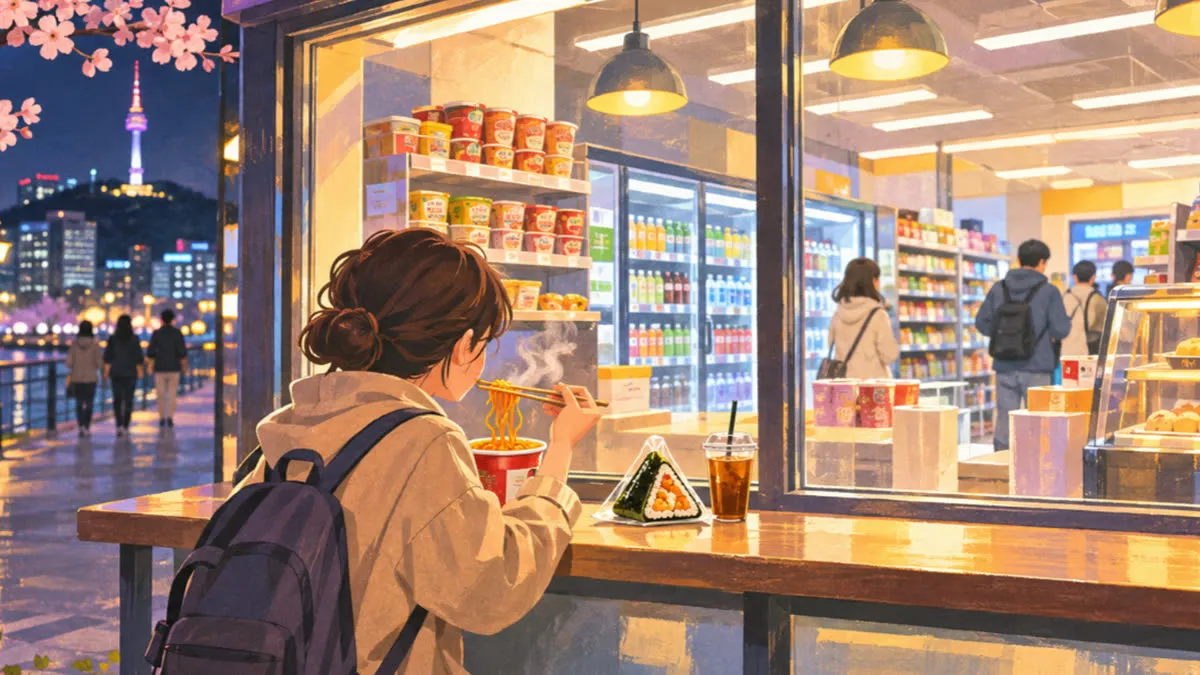
Korean convenience stores (CU, GS25, 7-Eleven and emart24) let you heat a meal in the store and top up a T-money card. Many of them never close. Three rules catch people out. T-money top-ups need cash. Stores are not allowed to give out plastic bags. In 2026 you must be born in 2007 or earlier to buy alcohol or tobacco.
The stores are everywhere. A Korea.net feature republished by the Ministry of Culture, Sports and Tourism in April 2026 counts 53,266 stores across the four big chains at the end of 2025. That is about one for every 900 people. We checked every rule below on November 19, 2026.
What you can and can't do at the counter
| You want to… | Can you? | What you need |
|---|---|---|
| Pay for food and drinks | Yes | Cash or a card. Foreign cards are widely used (see below) |
| Top up a T-money card | Yes, at stores with the T-money mark | Cash, 1,000–90,000 won per top-up |
| Get leftover T-money back | Yes, small balances | GS25 and 7-Eleven: up to 20,000 won. CU and emart24: up to 30,000 won. 500 won fee |
| Get a plastic bag | No | Bring a tote, or buy a paper bag, reusable bag or district rubbish bag |
| Buy painkillers or cold medicine | Only at registered 24-hour stores | 11 products on sale |
| Buy soju or beer | Yes | Born in 2007 or earlier (2026 rule). Carry your passport |
| Change foreign cash into won | Only at a few branches with a kiosk | Passport, banknotes only |
Which stores are open 24 hours
Many city stores never close. Stores in office buildings, on campuses and on quiet residential streets often close at night or on weekends. The hours are on the door, and Naver Map and Kakao Map list them too. Our map app guide explains which app to use.
The medicine rack is a quick way to tell. Under Article 44-2 of the Pharmaceutical Affairs Act, only a store open 24 hours a day, every day of the year, can register to sell household medicines. Money Today reported in December 2025 that 42,791 stores (about 78%) qualified as of June 2025. Another 11,876 did not.
What to buy, and where to see the price
Every item has a price on its shelf tag, and prices change often. Deals are marked 1+1 (buy one, get one free) or 2+1 (buy two, the third is free). Take the full number of items to the counter. The discount comes off when they are scanned. Some deals let you mix flavors and some don't, so ask before you pay if you aren't sure. The chain apps also show coupons and let you check stock: Pocket CU (포켓CU), Our Neighborhood GS (우리동네GS), and the 7-Eleven and emart24 apps. You don't need an app to shop.
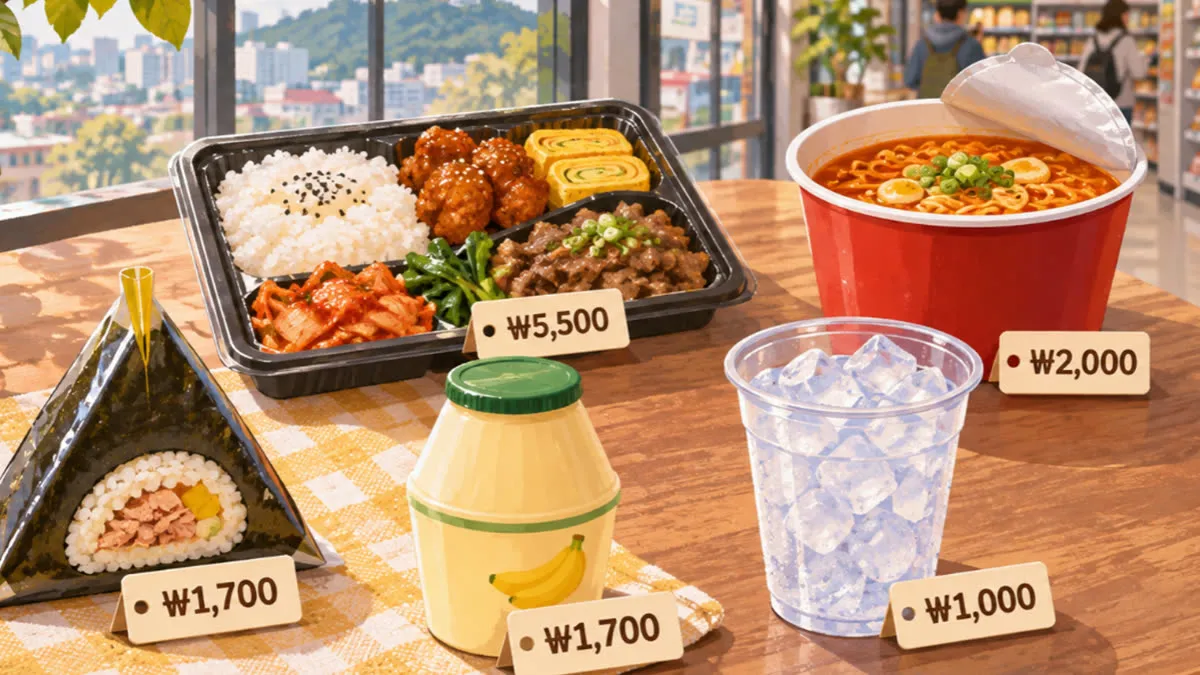
- Banana-flavored milk (바나나맛우유) is Binggrae's short, round bottle. It was the best-selling product among foreign shoppers at CU, GS25 and 7-Eleven in the first half of 2023 (The Korea Times). It is still the airport favorite. The Korea Herald reported in August 2026 that one of GS25's four Incheon Airport stores sells about 1,200 bottles a day. At CU's Incheon Airport stores, banana milk sales rose 43.1% from January 1 to August 17, 2026, compared with a year earlier.
- Triangle kimbap (삼각김밥) is a triangle of rice wrapped in seaweed. Open it by following the numbered tabs printed on the wrapper. That keeps the seaweed crisp.
- Dosirak (도시락) is a lunch box of rice and side dishes. The label tells you how long to microwave it.
- Cup ramyeon. Most stores have a hot-water dispenser. If you want a lot of choice, BGF Retail's Ramyun Library store in Hongdae stocks more than 230 kinds of instant noodles.
- Store-specific food. The 7-Eleven branch in Myeong-dong sells hot food such as pizza and chicken skewers. emart24's K-food Lab near Myeong-dong Station focuses on Korean desserts and snacks. CU had more than 370 character tie-in products in 2025, up from about 50 in 2021 (BGF Retail).
- Everyday items: phone cables, umbrellas, toiletries, masks, socks and batteries.
If you are landing at Incheon, the CU stores in the arrival halls sell more Tmoney Travel Cards than anything else. Next come banana milk, bottled water, Dubai-style chewy cookies and plug adapters. Sales of the travel card at CU's Incheon Airport stores rose 831.7% from January to mid-August 2026. If you are passing through on a stopover, see our Seoul layover guide.
How to eat a meal in the store
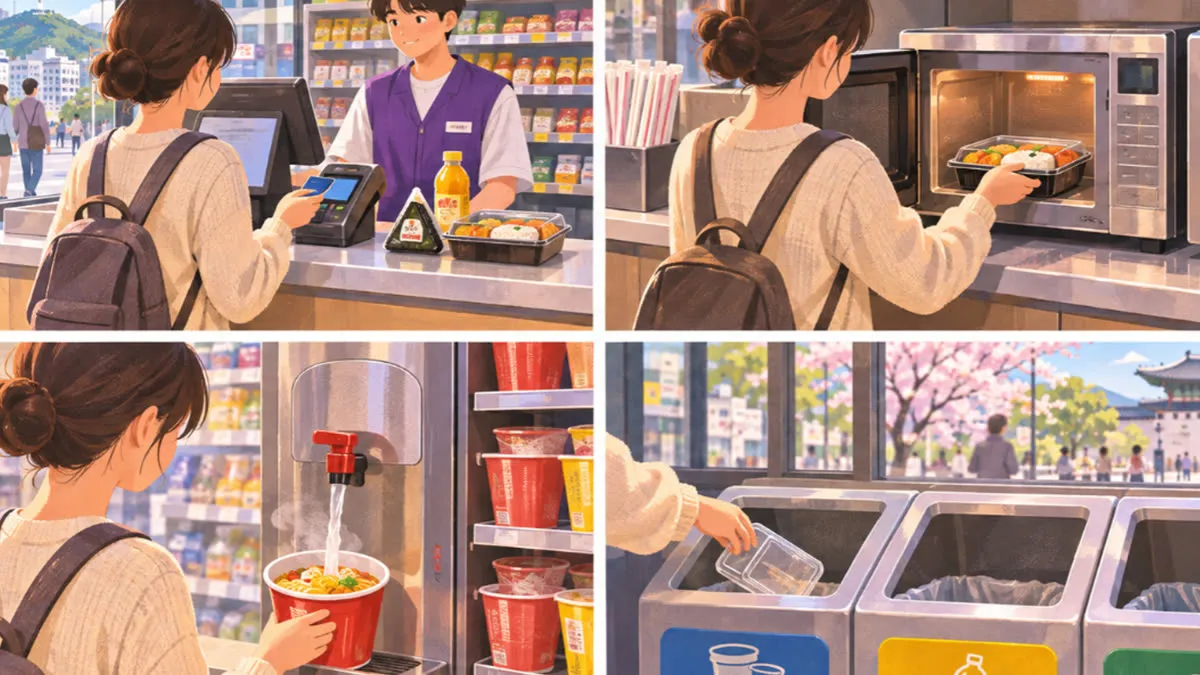
- Take your food to the counter and pay. Pay before you use the microwave or the hot water.
- Heat lunch boxes in the microwave for the time on the label. Remove any foil, and open or pierce the film if the label says so.
- For cup ramyeon, fill the cup to the line inside with hot water from the dispenser, close the lid and wait.
- Eat at the window counter or outside tables if the store has them.
- Pour leftover broth into the sink or bucket provided. Put cans, plastic and general waste in the labeled bins. Don't leave a cup of soup on the counter.
Paying with a foreign card, Alipay or WeChat Pay
Foreign cards are widely used. CU said its foreign-card sales in the first half of 2026 were up 115.1% in Seongsu, 35.3% in Myeong-dong and 32.5% in Hongdae compared with a year earlier (The Korea Herald). At GS25, Alipay and WeChat Pay made up 97.7% of foreign payment value in 2025, according to GS Retail. If you are not sure your app works, show it at the counter before you pay.
At the till you may hear 봉투 필요하세요? (Do you need a bag?). Say 영수증 주세요 if you want a receipt. More lines are in our Korean phrases for travelers.
Topping up and refunding T-money
These figures are from T-money's official guide. Our T-money card guide covers the card itself.
- Find a store showing the T-money mark. GS25, CU, 7-Eleven, Storyway and emart24 are all listed as top-up points.
- Hand over the card and cash and say 티머니 충전해 주세요 (Please top up my T-money). Each top-up can be 1,000 to 90,000 won. A card can hold up to 500,000 won.
- Bring cash. The only card accepted for top-ups is a Woori Bank-issued Woori check or credit card, at GS25 and Woori Bank ATMs (10,000–50,000 won each time). Foreign cards won't work.
- At GS25 and CU, you can put the change from a purchase onto your card, in 10-won units. This is a good way to use up coins.
- Before you fly home, ask for a refund of what's left. GS25 refunds balances under 20,000 won. 7-Eleven refunds up to 20,000 won, and CU and emart24 up to 30,000 won. The fee is 500 won, and you don't get back the price of the card. For larger balances, use a subway customer center or T-money's own refund service.
Why you won't get a plastic bag
Since November 24, 2022, convenience stores have not been allowed to hand out single-use plastic bags. That includes biodegradable plastic bags, even if you offer to pay. The law allows a fine of up to 3 million won. A one-year grace period ended in November 2023. At that point the Ministry of Environment said it would focus on getting stores to use alternatives rather than on fines. During the grace period, stores were still mostly using biodegradable bags: 70% of bags in the first half of 2023, according to the convenience store industry association.
What you can get instead is a paper bag, a reusable bag, or a volume-rate rubbish bag (종량제봉투, jongnyangje bongtu). The rubbish bag is issued for one local district, so it is only worth buying if you live there. Carrying a foldable tote is simpler.
The 11 medicines you can buy, and when to go to a pharmacy
Registered 24-hour stores can sell government-designated safety household medicines (안전상비의약품). Thirteen products are on the list. Two Tylenol products, the children's 80 mg tablet and the 160 mg tablet, have not been made since 2022. That leaves 11 on sale.
| Type | Products on the list | Example brands |
|---|---|---|
| Fever and pain relief | 5 | Tylenol, Children's Brufen syrup |
| Cold medicine | 2 | Panpyrin |
| Digestives | 4 | Beazet |
| Pain-relief patches | 2 | Jeil Cool Pap |
In July 2026, Money Today reported that the Ministry of Health and Welfare plans to raise the list to as many as 20 products from December 2026. It would be the first change since the scheme began in 2012. Until new products appear on the shelf, assume only the 11 above are sold. For anything else, go to a pharmacy (약국, yakguk). If it's an emergency, see Emergency Numbers in Korea.
Buying alcohol: the age rule and ID
The Youth Protection Act (청소년보호법) bans selling alcohol and tobacco to anyone under 19. The age is counted by year of birth, not by birthday, and everyone born in the same year qualifies on January 1. In 2026, that means anyone born in 2007 or earlier can buy, even if their birthday hasn't come yet. Staff may ask for ID, so carry your passport or Korean residence card in the evening.
Changing money at CU and GS25 kiosks
- CU put unstaffed exchange kiosks for foreigners in its Myeong-dong main branch and Yongsan I'Park Mall branch in November 2023. They change banknotes (not coins) in 15 foreign currencies into won. You scan your passport, and the limit is US$2,000 per person per day. The same kiosks sell the WOWPASS prepaid card (5,000 won at launch) and top it up from foreign cash.
- GS25 began testing kiosks in January 2023 at about 10 GS25 and GS THE FRESH stores, including ones in Gimpo Airport, Yeongdeungpo and Dongdaemun. They change 15 currencies into won and won into US dollars, yen, euros and yuan. They also turn foreign coins into GS25 points.
These details come from the 2023 launch announcements. We could not confirm which branches still have kiosks in November 2026, so ask at the store or check the chain's app before you make a special trip.
Other services at the counter
- Parcels and bills. Stores handle parcel pickup, and residents pay utility bills at the counter.
- ATMs. Many stores have one. With a foreign card, check the fee on the screen before you confirm.
- Tax refunds. Most stores don't offer them. emart24's K-food Lab near Myeong-dong Station has tax refund kiosks for international customers. See Tax Refund in Korea for Tourists for the thresholds.
- Missing persons. Since 2017, CU has run a missing-persons prevention system, I-CU, with the Korean National Police Agency. If you have lost a child or a vulnerable companion, you can go into a CU and ask for help. GS25 runs its own system for helping people in a medical emergency.
Sources
Last checked: — Prices, hours and rules in Korea change often; check the official pages below before you go.
- Ministry of Culture, Sports and Tourism (Korea.net) – Beyond the Corner Store: How Korea Transformed Convenience Retail
- T-money official site – recharge methods guide
- Asia Economy – Plastic bag ban at convenience stores from November 24 (Oct 18, 2022)
- Newsis – Environment ministry revises disposable product rules (Nov 7, 2023)
- Money Today via Supple – Convenience store safety medicines to expand to 20 items (Jul 20, 2026)
- Money Today – 24-hour rule keeps 11,876 stores from selling household medicine (Dec 21, 2025)
- Korea Herald via Asia News Network – Tourist wallets power convenience store growth (Aug 25, 2026)
- Etoday – CU introduces unmanned currency exchange kiosks and WOWPASS (Nov 27, 2023)
- Etoday – GS Retail launches foreign currency exchange kiosks at GS25 (Jan 2, 2023)
- Asia Business Daily – GS25 foreign payments up 74%, Alipay and WeChat dominate (Jan 29, 2026)
- The Korea Times – Convenience stores become popular among foreign tourists (Aug 8, 2023)
- LawTalk – How 'year age' works for buying alcohol and tobacco
Facts were checked against the sources above, and the article was written by Seoul Sidekick with the help of AI tools. Report an error