Gwangjang Market Food Guide: What to Eat, How to Order, When to Go
Gwangjang Market food alley: 2026 prices for bindaetteok, yukhoe and mini kimbap, hours, Exit 8 access, how to pay and the overcharging record.
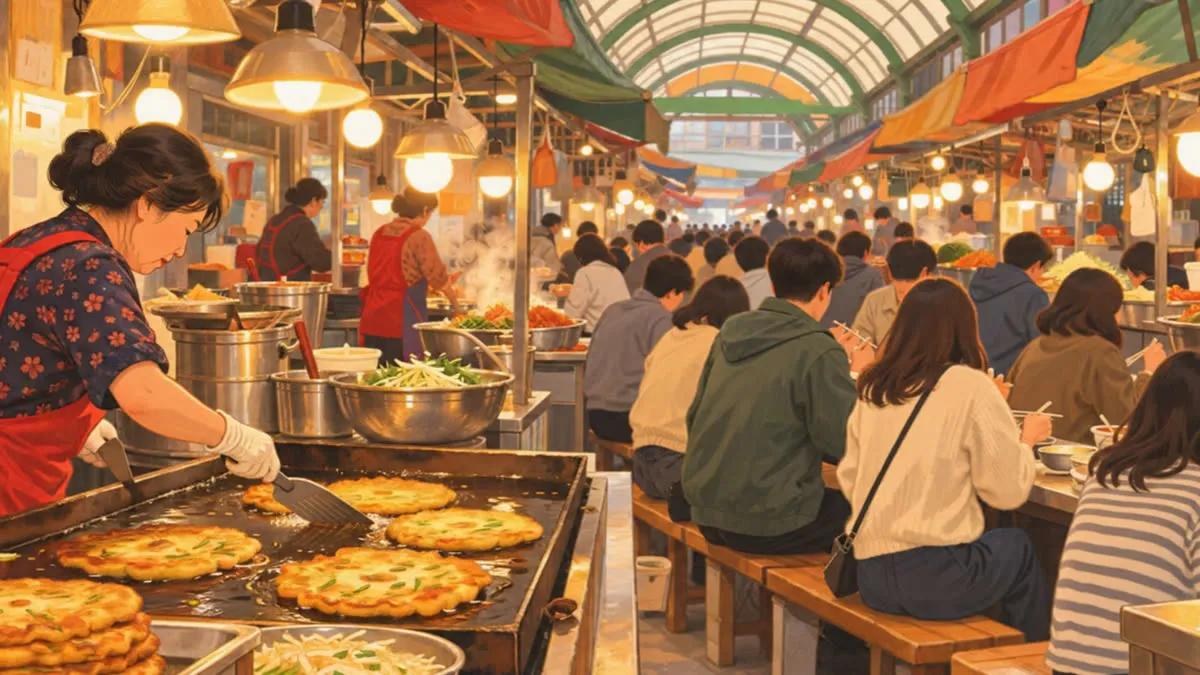
Go to the covered food alley (먹자골목, meokja golmok) in the middle of Gwangjang Market. It is open every day from 09:00 to 23:00. Order the mung bean pancake (bindaetteok), mini kimbap, yukhoe (raw beef) and a bowl of noodles. Two people sharing one of each should budget about 40,000–50,000 won before drinks. Check the price and the posted weight on the menu board before you sit down, and carry 5,000- and 10,000-won notes.
Getting there and opening hours
- Address: 88 Changgyeonggung-ro, Jongno-gu, Seoul (서울 종로구 창경궁로 88)
- Jongno 5-ga Station (Line 1), Exit 8: connects directly to the market.
- Euljiro 4-ga Station (Lines 2 and 5), Exit 4: about 100 m away.
- Map apps: search 광장시장 in Naver Map or Kakao Map (which map app to use in Korea).
Seoul city's MediaHub published these hours in February 2025:
| Section | Open | Closed |
|---|---|---|
| Food alley (먹자골목) | Every day, 09:00–23:00 | No closing day listed |
| General shops (fabric, bedding, hanbok) | Mon–Sat, 09:00–18:00 | Sunday |
| Vintage clothing arcade (구제상가) | Mon–Sat, 10:00–19:00 | Sunday |
These are the market's hours, not each stall's. Stalls set their own closing times on quiet nights. If you are going for one particular stall, go in the early evening rather than near 23:00. The food alley stays open on Sundays, but the fabric and vintage sections around it are shut. The market's own site is kwangjangmarket.co.kr.
The market started in 1905, when Korean merchants set it up. Seoul city counted 5,628 shops there in 2024. Most of them sell fabric and clothing, not food. The public toilets were rebuilt to a universal-design standard in 2024.
What to order and what it cost in 2026
No price is fixed across the market. The same dish costs different amounts at different stalls. These figures come from a 2026 price guide and from Korean news reports in January and August 2026:
| Dish | Price reported in 2026 | Source detail |
|---|---|---|
| Bindaetteok (녹두빈대떡), 1 pancake | 5,000–8,000 won | Price guide; extra toppings cost more |
| Mini kimbap (꼬마김밥), 1 portion | 3,000–5,000 won | Price guide |
| Yukhoe (육회), 1 plate | 20,000–25,000 won | Price guide |
| Noodles / kalguksu (칼국수) | 5,000–8,000 won | Price guide |
| Tteokbokki (떡볶이) | 3,000 won (6 rice cakes, 214 g) to 5,000 won | Digital Times, Jan 2026; Channel A, Aug 2026 |
| Sundae (순대), 1 portion | 7,000 won (464 g) to 8,000 won | Digital Times, Jan 2026 |
| Hotteok (호떡), 1 piece | 2,000 won | Digital Times, Jan 2026 |
| Nutella cream cheese waffle or crepe | 4,500 won | Digital Times, Jan 2026 |
| Bottled water, where stalls sell it | 1,000–2,000 won on menu boards | Channel A, Aug 2026 |
The 40,000–50,000 won figure for two people covers one each of bindaetteok, kimbap, yukhoe and noodles. Other pancakes (jeon), octopus and yukhoe bibimbap raise the bill quickly. Share each dish rather than ordering one per person.
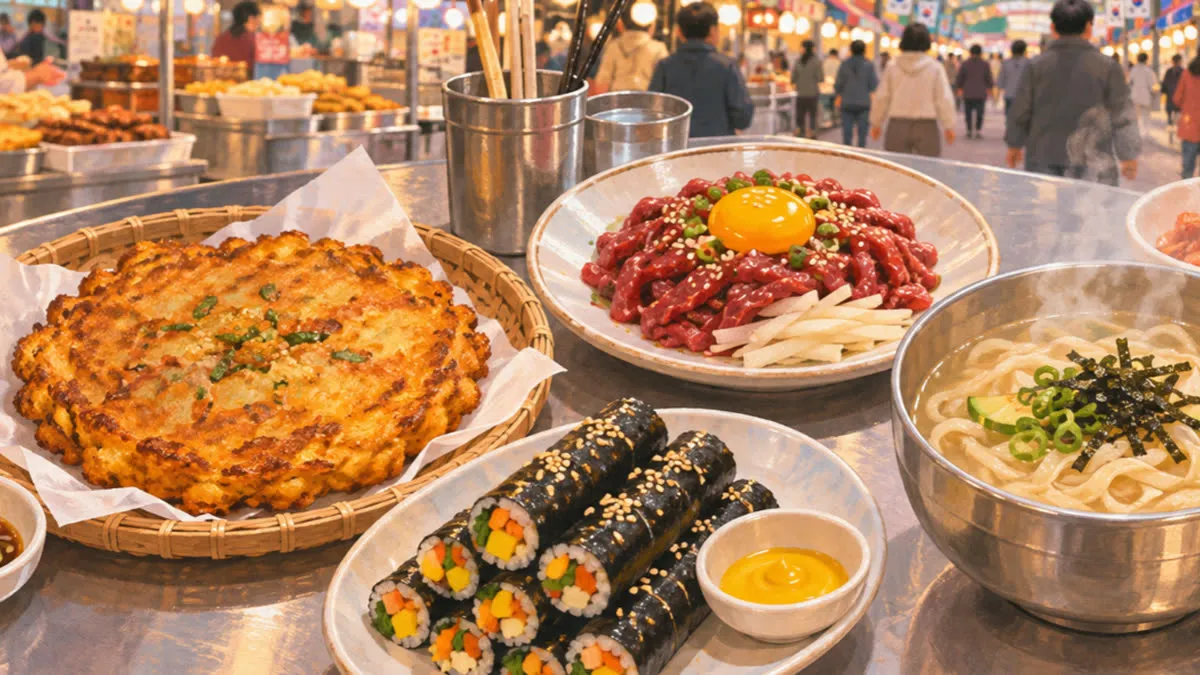
Bindaetteok. This is the market's best-known dish: a thick pancake of ground mung beans, fried on a griddle. One pancake is enough for two people as a first dish.
Yukhoe. Seasoned raw beef, served at a row of specialist restaurants. It is usually the most expensive thing on the table, so check the weight before you order. When Seoul city announced weight labeling in 2023, its example was one shop charging 19,000 won for 200 g and another charging 28,000 won for 300 g. The labels let you compare price per gram. Skip raw beef if you are pregnant or have a weak stomach.
Mini kimbap. Finger-size rolls of rice and vegetables. Signs used to call them mayak gimbap (마약김밥, 'addictive kimbap'). Many now use the plainer name, kkoma gimbap (꼬마김밥, 'little kimbap').
Noodles. Kalguksu is a bowl of knife-cut wheat noodles in hot broth. It costs less than yukhoe, and it makes a good last dish.
How ordering at a stall works
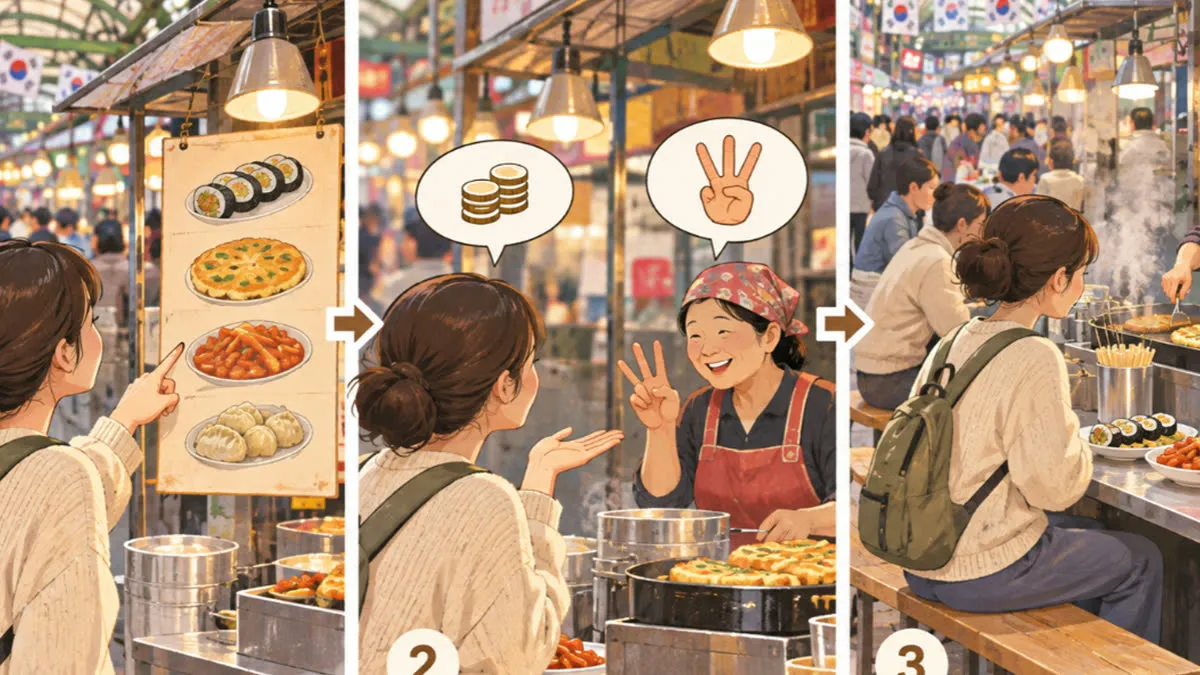
- Walk the alley once before you choose. Many stalls sell the same dishes. Compare the prices on the boards, and the weights where a stall posts them.
- Sit at a free spot on the bench. Nobody seats you. If a stall is full, wait beside it.
- Point at the board or the food. Say 이거 하나 주세요 (igeo hana juseyo, 'one of this, please'). Our page of Korean phrases for travelers has more lines.
- Ask the price before they cook: 얼마예요? (eolmayeyo?, 'how much?').
- Ask how to pay before you order: 카드 돼요? (kadeu dwaeyo?, 'can I pay by card?'). Stalls differ on card, cash and bank transfer.
- Pay the posted price and nothing more. Korea has no tipping (tipping in Korea).
Paying: bring small notes
In its 2025 market guide, Seoul's MediaHub reported that many shops still turned down cards. The 2026 price guide tells readers to bring 10,000- and 5,000-won notes and to ask about card, cash and transfer before ordering. In 2023 the city announced merchant training that bans steering customers toward cash, so a vendor should not refuse a card it normally takes. If a stall does take cards, pay by card: you get a record of the amount.
The overcharging record, and how to avoid it
Korean media keep running Gwangjang overcharging stories. These are the documented ones:
- December 2023: Seoul city, Jongno-gu district, the market's merchant association and the food-stall association announced joint measures. Stalls would post the weight next to each price, phased in during the first half of 2024. Mystery shoppers would check prices and portions. The merchant association would run spot checks, with business suspension as a possible penalty. A price-consultation body led by the merchants, with the city and district taking part, would settle price rises. The announcement was a plan. It did not confirm that every measure would be carried out.
- November 2025: a YouTuber ordered an 8,000-won sundae. The vendor added meat without being asked and charged 10,000 won.
- December 2025: a YouTube comparison (reported by Digital Times in January 2026) bought sundae at both markets. Gwangjang charged 7,000 won for 464 g. Gyeongdong Market charged 5,000 won for 659 g.
- August 2026: a Channel A reporter was charged 1,500 won for water. The same stall's menu board said 1,000 won, and a second board said 2,000 won. A Jongno-gu official told the broadcaster that the district investigates violations such as missing price displays on the spot. The reporter said a penalty-point system had run since June, and that in three months no vendor had received a single point.
What to do about it:
- Order only what is on the board. If you want plain sundae, say 순대만 주세요 (sundae-man juseyo, 'just sundae, please') so nothing is added.
- Ask what water costs before you take a bottle. Or buy it at a convenience store before you go in (Korean convenience stores).
- Ask for the total before you pay. Count your change.
- If the bill does not match the board, point at the posted price. Note the stall's name or number and take a photo of the board. Seoul city's main phone line is the 120 Dasan Call Center.
Sundays and late evenings
On Sundays only the food alley is open. The fabric shops and the vintage arcade close, so if you also want to shop for clothes, go Monday to Saturday before 18:00–19:00. In the evening, stalls start closing at different times well before the alley's 23:00 closing.
Sources
Last checked: — Prices, hours and rules in Korea change often; check the official pages below before you go.
- Seoul Metropolitan Government MediaHub – Gwangjang Market guide (hours, exits, address, shop count), Feb 11, 2025
- Seoul Metropolitan Government MediaHub – Gwangjang Market weight labeling and anti-overcharging measures, Dec 4, 2023
- Digital Times via Daum – Gwangjang vs Gyeongdong market price and portion comparison, Jan 24, 2026
- Channel A via Daum – Water pricing and Jongno-gu inspections at Gwangjang Market, Aug 25, 2026
- kgosu – Gwangjang Market food tour prices and cash tips (Oct 2026)
Facts were checked against the sources above, and the article was written by Seoul Sidekick with the help of AI tools. Report an error