Alien Registration Card Korea: Who Needs One and How to Apply
Who must register within 90 days of entry, how to book on HiKorea, the documents, the 35,000 won fee, the 6–8 week wait and the mobile residence card.

If you will stay in Korea for more than 90 days, you must register with immigration within 90 days of the day you entered and get a residence card (외국인등록증, still often called the ARC). Book a visit on HiKorea (hikorea.go.kr), then go in person to the immigration office that covers your address with your passport, one 3.5 x 4.5 cm photo, proof of address and your visa's documents. The IC-chip card costs 35,000 won (roughly US$25). It takes about 6 to 8 weeks to arrive.
We checked these details against the Ministry of Justice, university international offices and news reports on November 19, 2026. The immigration contact center is 1345 (no area code, English available) if your case differs.
Who has to register, and who doesn't
The Ministry of Justice rule is that a foreigner who plans to stay more than 90 days from entry registers within 90 days of entry. The 90 days count from the date stamped at the airport, not from when you signed a lease or started a job. Yonsei University's visa office says staying past 90 days without registering is illegal. Both Yonsei and Seoul National University (SNU) say you can be fined for it.
Exceptions:
- Diplomats and international organization staff. The ministry says staff of foreign missions and international organizations in Korea, people with diplomat-like privileges under agreements with Korea, and their families may be exempt. Yonsei lists A-1, A-2 and A-3 holders and their families.
- Overseas Koreans with F-4 status can file a domestic residence report (국내거소신고) instead and get a residence report card. If they do not file one, they must register within 90 days like everyone else.
- Children under 17. The ministry says immigration may choose not to issue a card to a child under 17. Ask your office how this applies to your child.
- Multiple-entry D-2 students. SNU says a student with a multiple-entry D-2 visa does not have to register if their latest stay is 90 days or less. SNU still strongly recommends registering.
Once registered, you get a foreign registration number. Under Article 88-2 of the Immigration Act, the card has the same legal effect as a Korean resident registration card. Banks, phone carriers and many apps ask for it. SNU, for example, says students need it for a Korean debit card and for the dormitory payment system. See opening a bank account in Korea for what the card unlocks there.
How to apply, step by step
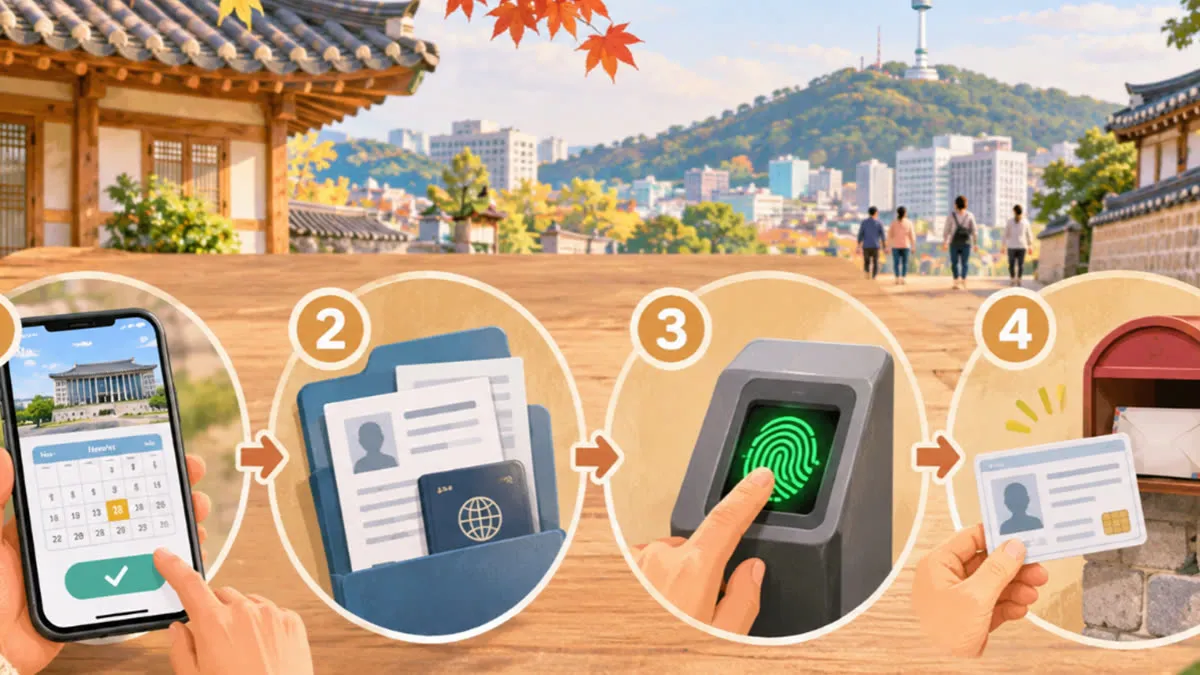
- Find the office that covers your address. You must apply at the immigration office (출입국·외국인관서) for the area where you live. Seoul has more than one office. HiKorea shows which one covers your address. Two that university pages list:
- Seoul Immigration Office: 151 Mokdongdong-ro, Yangcheon-gu. SNU lists it as open Monday to Friday, 9am to 6pm, tel. 02-2650-6214.
- Seoul Southern Immigration Office: 48 Magokseo 1-ro, Gangseo-gu. Yonsei lists it for Seodaemun-gu, among other districts. Take Line 5 to Magok Station, leave by Exit 1 and walk straight for about 5 minutes. Tel. 02-6980-4700.
- Book a visit on HiKorea. The ministry tells applicants to book before going in. SNU says slots are very hard to get at the end of the school vacation and the start of a semester. Book as soon as you have an address, and keep checking for slots that open when other people cancel. Yonsei warns that if you arrive late in the day at a busy Seoul office, you may not be seen that day.
- Prepare your documents (table below). Your proof of address is where most applications stall.
- Arrive early. SNU says waits at the start of a semester run from 2 to more than 4 hours. Its tips: take a number ticket first, fill in the form while you wait, and use the photo booth inside the office if you have no photo.
- Pay the fee. SNU says its office takes payment through the machines on site and wants the transaction receipt, not cash. An older Yonsei page says cash only. Ask your own office when you book.
- Choose pickup or mail. SNU says you can collect the card at the office or have it mailed to you.
- Wait about 6 to 8 weeks. SNU says up to 6 to 8 weeks (working days only). Yonsei says about 6 weeks. Yonsei also says the office keeps your passport for the whole approval period. SNU says you must not leave Korea until the process is finished, so do not book a trip abroad for those weeks.
Documents to bring
| Document | Details |
|---|---|
| Application form | Fill it in before your visit or at the office |
| Passport | The original |
| One photo | 3.5 x 4.5 cm, face 2.5–3.5 cm long, white or plain background, no border, taken within 6 months, facing forward, no hat or sunglasses (ministry). SNU adds: show your ears |
| Proof of address | See below |
| Visa-specific documents | Students: certificate of enrollment. Workers and other visa types have their own lists. The ministry links a table (별표 5의2) by status of stay |
| TB test certificate | Only if you are a national of a listed high-TB country and did not submit one with your visa application. SNU's list: China, Vietnam, Indonesia, Thailand, the Philippines, India, Nepal, Bangladesh, Pakistan, Sri Lanka, Myanmar, Cambodia, Laos, Malaysia, Mongolia, Russia, Uzbekistan, Kyrgyzstan and East Timor |
| Fee | 35,000 won |
What counts as proof of address
SNU's list, which is the most detailed we found:
- Lease in your name: the contract, showing the full typed address, the signatures of tenant and landlord, and the length of stay. Our guide to renting an apartment in Seoul explains the contract types.
- Dormitory: a dormitory residence certificate.
- Goshiwon, shared house, guesthouse or Airbnb: a confirmation of residence or a contract, the business's registration certificate and a payment receipt. The addresses must match, and the contract must show your move-in date. A bank transfer record can replace the receipt. For Airbnb, print the receipt page.
- A friend's home, or a lease not in your name: a confirmation of residence with your start date and a copy of the owner's ID card (front and back). If the address on the ID differs, you also need the contract.
If you live in a goshiwon, an Airbnb or a friend's place, get the owner's documents before the day of your appointment.
What the card costs
The Ministry of Justice began issuing a new card with an IC chip in January 2025. Newsis reported in January 2025 that the IC-chip card costs 35,000 won, and SNU lists 35,000 won for both a new card and a reissue. Older pages still show 30,000 won (Yonsei), and one SNU tip says 33,000 won. Those figures are out of date.
While your card is being made, SNU says you can get a registration certificate (외국인등록사실증명) for 2,000 won at an immigration office or a local community service center. Call 1345 first to check that it can be issued for you yet.
The mobile residence card
Since January 10, 2025, registered foreigners aged 14 and over can add a mobile residence card to the government's Mobile ID app (모바일 신분증) on a smartphone in their own name. The ministry says it has the same effect as the plastic card at public offices, financial institutions and hospitals.
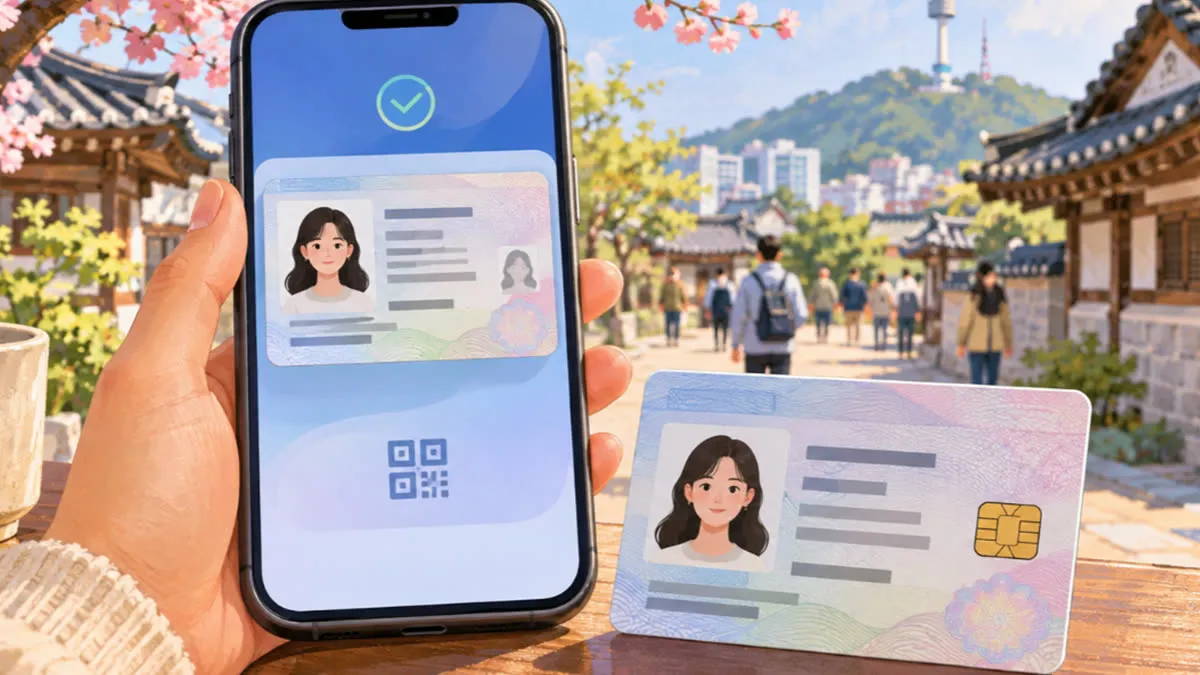
- If you have the IC-chip card: the app reads the card. If you change phones or delete the app, you can issue it again from the card without going to an office.
- If you have an older card without a chip: go to an immigration office and scan the QR code shown at the counter with the app. Newsis says this is free, but you must go back to the office every time you change phones or delete the app.
You need a phone number in your own name, so set up a Korean SIM or eSIM early. Carry the plastic card as well, because some places may still ask for it.
Deadlines after you have the card
| Change | Deadline | Source |
|---|---|---|
| You move house | Report within 15 days, with your passport, your card and a change-of-address report form | Yonsei |
| New passport, or a change of name, sex, date of birth or nationality | Report within 15 days | Yonsei |
| Card lost, stolen or damaged | Apply for a new card within 14 days (SNU) or 15 days (Yonsei). Bring your passport, a photo, the form and 35,000 won | SNU, Yonsei |
| Leaving Korea for good | Hand in the card at the airport | SNU |
Yonsei says reporting late breaks Articles 35 and 36 of the Immigration Act and can bring a fine.
If you are travelling abroad and coming back
Yonsei says registered foreigners with A-1 to A-3, D-1 to F-3, or F-6 to H-2 status do not need a re-entry permit if they return within 1 year, and F-5 holders within 2 years. SNU tells its students to get a re-entry permit and carry the card. If you are unsure about your status, call 1345 before you book. Either way, travel with the card itself, not just a photo of it.
If you have already missed the 90-day deadline
Do not wait longer. Call 1345 or contact the office that covers your address, then book a visit on HiKorea. The fine grows the later you report, and neither university page gives an amount. Before your visit, find the building and the right entrance on a Korean map app. Google Maps walking directions are limited in Korea.
Sources
Last checked: — Prices, hours and rules in Korea change often; check the official pages below before you go.
- Korea Immigration Service – 외국인등록증 안내
- Korea Immigration Service – 모바일 외국인등록증 발급
- Newsis – 행안부·법무부 모바일 외국인등록증 발급 개시
- Seoul National University Office of Global Affairs – Residence Card
- Yonsei University Global One-Stop – Maintaining Visa Status (scholars)
Facts were checked against the sources above, and the article was written by Seoul Sidekick with the help of AI tools. Report an error