Renting an Apartment in Seoul: Jeonse, Wolse, Deposits and Scams
Seoul rentals: jeonse vs wolse, June 2026 rents, agent fee caps, and the register, fixed-date and address steps that keep your deposit safe.

Most Seoul rentals start with a large refundable deposit (보증금, bojeunggeum). With wolse you pay a smaller deposit, often 10 million won (about US$7,000) for a studio, plus monthly rent. With jeonse you pay one large deposit and no rent. In June 2026 the jeonse average for a small Seoul one-room was about 222 million won. To protect the deposit, do three things: check the property register before you pay, report your new address within 15 days of moving in, and get a fixed-date stamp (확정일자) on your lease.
We checked the laws, fees and figures below on the Easy Law (찾기쉬운 생활법령), Seoul city and district office pages and in recent market reports on November 19, 2026.
The three lease types
- Wolse (월세): a deposit plus monthly rent. Market reports convert rents to a 10 million won deposit so they can be compared.
- Jeonse (전세): one large deposit and no monthly rent. You still pay maintenance fees and utilities. You get the whole deposit back when you leave, if the landlord can pay.
- Ban-jeonse (반전세): a larger deposit with lower monthly rent.
Most listings also have a maintenance fee (관리비, gwanribi). Ask what it covers (cleaning, elevator, internet, water) before you compare two places. Near universities it averaged 84,000 won a month in July 2026.
What a small studio costs in Seoul (2026 figures)
| One-room, 33㎡ or less | Figure | Data |
|---|---|---|
| Wolse, Seoul average (villas and multi-unit houses) | 640,000 won/month (about US$440), at a 10 million won deposit | June 2026 transactions (Dabang) |
| Wolse, Gangnam-gu | 1.02 million won/month, 158% of the Seoul average | June 2026 transactions (Dabang) |
| Jeonse, Seoul average (villas and multi-unit houses) | 221.97 million won (about US$152,000) | June 2026 transactions (Dabang) |
| Near 10 major Seoul universities | 625,000 won/month + 84,000 won maintenance, at a 10 million won deposit | July 2026 listings on the Dabang app |
| Near Ewha Womans University | 767,000 won/month | July 2026 listings |
The June figures come from Dabang's monthly report, which uses government transaction data. The university figures are asking prices on Dabang's app, so they are a separate data set. Ten districts were above the June Seoul average: Gangnam (158%), Seongdong (134%), Yongsan (130%), Dongdaemun and Seocho (116% each), Gwangjin (111%), Mapo (106%), Yangcheon and Jung (102% each) and Seongbuk (101%). Flats in large apartment complexes cost well above these studio figures.
If a listing is far cheaper than similar places nearby, find out why before you send any money.
Jeonse or wolse if you are new to Korea
Start with wolse. You put less money at risk, and leaving after a year or two costs you little. Jeonse puts a sum the size of a house deposit with one landlord. The best-known fraud pattern is a jeonse deposit that is close to, or above, what the home would sell for (깡통전세, "empty-can jeonse").

Consider jeonse only if all three are true:
- You will stay at least two years.
- Your deposit plus the mortgages on the register is well below recent sale prices for similar units.
- The home qualifies for a jeonse deposit return guarantee (전세보증금 반환보증). Ask your agent which guarantor will accept it, and check the conditions with the guarantor before you sign.
Renting step by step
- Get your Alien Registration Card and a Korean bank account first. Agents and landlords ask for the card, and you need the account for transfers. See our guides to the Alien Registration Card and opening a bank account.
- Search listings on Naver Real Estate (네이버 부동산), Zigbang (직방) or Dabang (다방). Each listing shows the deposit, rent and maintenance fee.
- View the place with a licensed agent (공인중개사). Check water pressure, mold, heating and windows, and come back once at night to check the noise. The Seoul Real Estate Information Plaza (land.seoul.go.kr) lets you look up registered agent offices.
- Run the checks in the next section before you pay anything.
- Pay the contract deposit (계약금) only into an account in the registered owner's name. Do not pay into the agent's or a "manager's" account.
- Sign the lease (임대차계약서). Write extra terms in the special conditions (특약), such as the date your deposit will be returned and a ban on new loans against the home before your protection starts. Every page needs both signatures or seals, and any correction needs to be signed.
- Pay the balance (잔금) on move-in day. Check the property register again that morning.
- Report your address and get the fixed-date stamp the same day (see below).
- File the lease report within 30 days of signing. In Seoul this is required when the deposit is over 60 million won or the rent is over 300,000 won a month. Landlord and tenant file together at the community service center (주민센터) or online at rtms.molit.go.kr. Foreigners use their passport or alien registration number. If one side refuses, the other can file alone with the lease attached. The fine for not filing, filing late or filing false details is up to 1 million won. If you attach the lease to the report, the lease counts as having a fixed date. Helpline: 1533-2949.
How your deposit is protected: address report and fixed date
The Housing Lease Protection Act protects you only once you have moved in and registered your address. Registered foreigners do this with a change-of-residence report (체류지 변경신고). The Immigration Act (Article 88-2) treats alien registration and this report as the equivalent of a Korean resident registration and move-in report.
- Deadline: within 15 days of moving, says Yeongdeungpo-gu Office. File at the community service center or district office for the new address, or at the immigration office for that area. Bring your Alien Registration Card and the lease in your name. After the deadline you have to file at immigration (call 1345).
- Fixed date (확정일자): bring the original lease to a community service center, a district court, a registry office or a notary. The fee is 600 won, plus 100 won for each page after the fourth. With your address registered and the stamp on the lease, you are repaid ahead of later creditors if the home is auctioned.
- When protection starts: at 00:00 the day after you have moved in and registered. A mortgage the landlord registers on your move-in day ranks ahead of you. A special clause banning new loans until the next day closes that gap.
If the home is auctioned and your deposit is small: in Seoul, a tenant with a deposit of 165 million won or less can recover up to 55 million won before other creditors. You must have moved in and registered before the auction application was registered, keep living there and stay registered until the claim deadline, and file a claim for distribution (배당요구) with the court. The total paid out this way is capped at half the home's value. These amounts apply from February 21, 2023. Against a mortgage registered before that date, the older, lower amounts apply.
Checks that catch most deposit scams
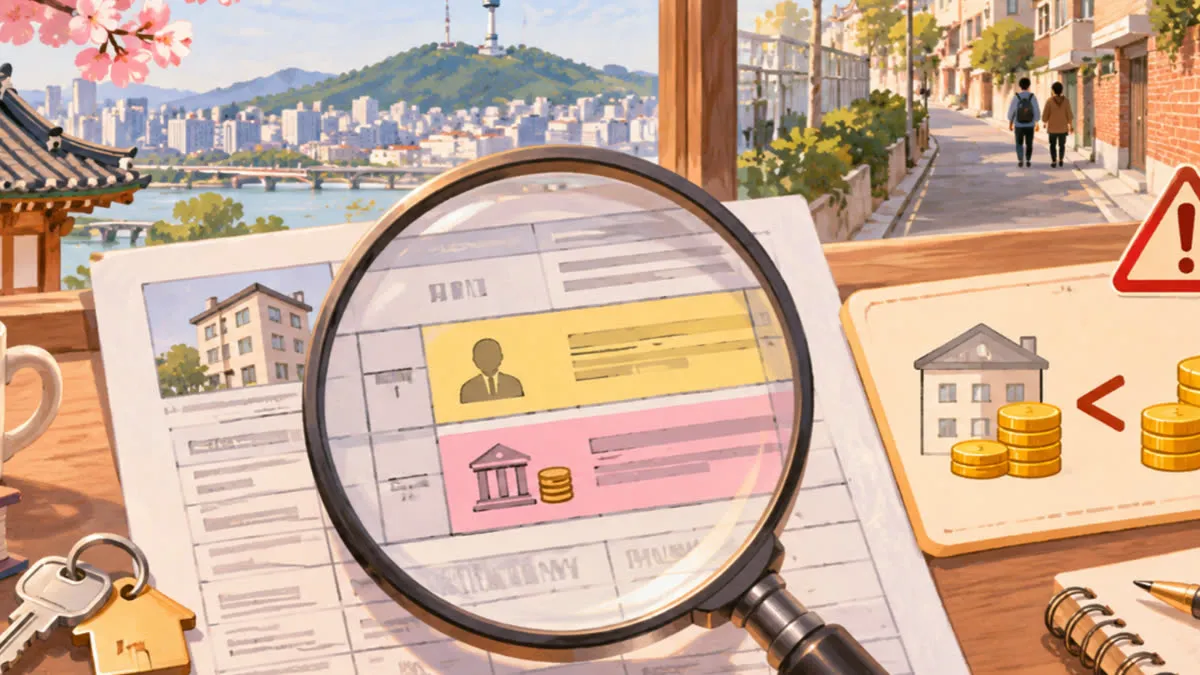
- Property register (등기부등본): get it yourself from the Internet Registry Office (iros.go.kr). The 갑구 section shows the owner. The person signing must be that owner, and their ID must match. The 을구 section shows mortgages (근저당). Add the mortgage amounts to your deposit. If the total comes near the sale price, walk away.
- Sale prices: compare your deposit with recent sales of similar units on the government transaction price system (rt.molit.go.kr).
- Building ledger (건축물대장): for villas, multi-unit houses and officetels, look for an illegal-building note (위반건축물). It can block guarantees and loans.
- Landlord's unpaid taxes: since April 18, 2023, landlords must show you a tax payment certificate (납세증명서) when you sign. Unpaid taxes can rank ahead of your deposit, so if the landlord will not show one, do not sign.
- Payee: pay only an account in the registered owner's name.
- Jeonse priced far below the area: treat it as a warning sign, not a bargain.
Seoul agent fee caps for rentals
The Seoul ordinance in force since December 30, 2021 sets the maximum agent fee (중개보수). You can negotiate below the cap. VAT is extra. You pay your own agent, and the landlord pays theirs.
| Transaction amount | Max rate | Cap |
|---|---|---|
| Under 50 million won | 0.5% | 200,000 won |
| 50M to under 100M | 0.4% | 300,000 won |
| 100M to under 600M | 0.3% | none |
| 600M to under 1.2B | 0.4% | none |
| 1.2B to under 1.5B | 0.5% | none |
| 1.5B and over | 0.6% | none |
For wolse, the transaction amount is deposit + (monthly rent × 100). If that comes to less than 50 million won, use deposit + (monthly rent × 70) instead.
- 10 million won deposit with 700,000 won rent: 10M + 70M = 80 million won. 0.4% is 320,000 won, so the 300,000 won cap applies.
- 300 million won jeonse: up to 900,000 won plus VAT.
- Officetels of 85㎡ or less with their own kitchen, flush toilet and bathroom: up to 0.4% for rentals. Other officetels: up to 0.9%.
Ask for the fee in writing before you sign.
Renewal, rent increases and moving out early
- Right to renew (계약갱신요구권): you can ask once for another two years. Ask between six months and two months before the lease ends. The landlord can refuse only for reasons set out in the law. Examples are two months of unpaid rent, subletting without consent, or the landlord or their parents or children moving in. If the landlord refuses so they can move in, then rents to someone else within the two years, they owe you damages. The damages are the largest of three months' rent, two years of the rent difference, or your actual loss.
- Increase cap: at renewal the deposit or rent can rise by at most 5% (1/20). No increase is allowed within a year of the lease or the last increase.
- Deposit-to-rent conversion: if part of the deposit is turned into monthly rent, the rate is the lower of 10% or the Bank of Korea base rate plus 2 percentage points.
- Automatic renewal: if neither side gives notice in time, the lease renews for two years on the same terms. You can then end it at any time. Notice takes effect three months after the landlord receives it.
Moving in and out: protecting yourself
- Return date: many landlords return the deposit only when the next tenant pays theirs. Write the return date into the special conditions.
- Records: keep the transfer receipts, the stamped lease and the register printout until the whole deposit is back in your account.
- Meters: photograph the gas, electricity and water meters on move-in day.
- Short stays: if your visa does not let you register a residence, the protections above do not apply. Choose places with small deposits, such as goshiwon (고시원) rooms, share houses or furnished studios rented by the month.
- Reading the lease: camera translation in Papago helps with the main text. Have a Korean speaker read the special conditions before you sign.
Sources
Last checked: — Prices, hours and rules in Korea change often; check the official pages below before you go.
- Seoul Real Estate Information Plaza – Brokerage fee table
- Easy Law – Small deposit priority repayment
- Easy Law – Opposability and fixed date
- Easy Law – Housing lease reporting system
- Easy Law – Lease renewal
- Easy Law – Rent and deposit increases
- Yeongdeungpo-gu Office – Foreigner change-of-residence report
- Ministry of Justice – Amended Housing Lease Protection Act (tax certificate duty)
Facts were checked against the sources above, and the article was written by Seoul Sidekick with the help of AI tools. Report an error