Chuseok and Seollal: Dates, Closures and Tips for Visitors
Chuseok and Seollal dates for 2027–2028, what closes, free palace entry, holiday train booking, late subway hours, open clinics and customs for visitors to Korea.
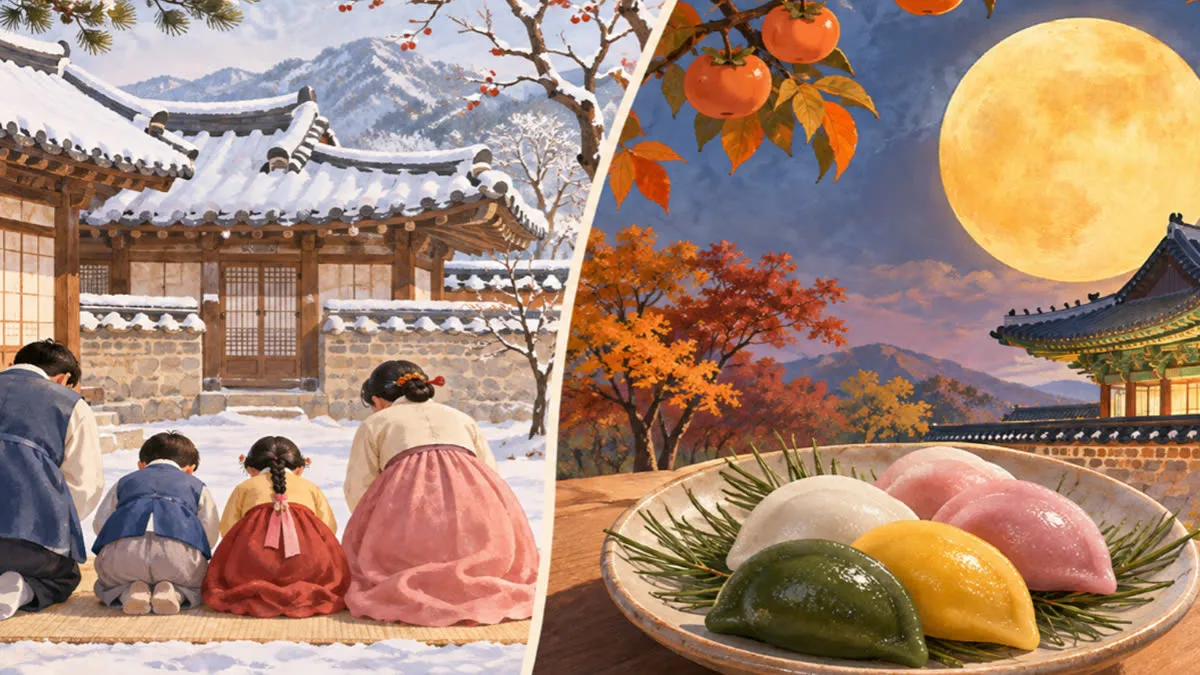
Chuseok and Seollal are Korea's two biggest holidays. Each is a three-day public holiday set by the lunar calendar. The next ones are Seollal on February 6–8, 2027 (with a substitute holiday on February 9) and Chuseok on September 14–16, 2027. For visitors, three things change. Intercity trains fill up. Small shops set their own holiday hours. Seoul's four main palaces, Jongmyo Shrine and the Joseon royal tombs have opened free over each holiday in 2026.
Chuseok and Seollal dates for 2027 and 2028
Each holiday covers the main day plus the day before and the day after. If any of the three days falls on a Sunday, or on another public holiday, the government adds a substitute holiday (daechae gonghyuil). It goes on the first working day after the holiday. A Saturday does not count for these two holidays.
| Holiday | Main day | Days off | Substitute holiday |
|---|---|---|---|
| Seollal 2027 | Sun, Feb 7 | Sat, Feb 6 – Mon, Feb 8 | Tue, Feb 9 |
| Chuseok 2027 | Wed, Sep 15 | Tue, Sep 14 – Thu, Sep 16 | None |
| Seollal 2028 | Thu, Jan 27 | Wed, Jan 26 – Fri, Jan 28 | None |
| Chuseok 2028 | Tue, Oct 3 | Mon, Oct 2 – Wed, Oct 4 | Thu, Oct 5 |
The Korea AeroSpace Administration published the official 2027 calendar on June 29, 2026. The 2028 dates come from the Korea Astronomy and Space Science Institute (KASI) calendar page. KASI marks them as provisional until the official calendar for that year comes out. In 2028 the Chuseok main day falls on National Foundation Day (October 3), so a substitute day is added on October 5. For later years, look up the year on KASI's calendar page at astro.kasi.re.kr.
Seollal 2027 starts on a Saturday and runs through the substitute holiday, so most workers get four days off in a row (Saturday to Tuesday).
How families spend Seollal, the Lunar New Year
Seollal mostly happens at home, inside the family.
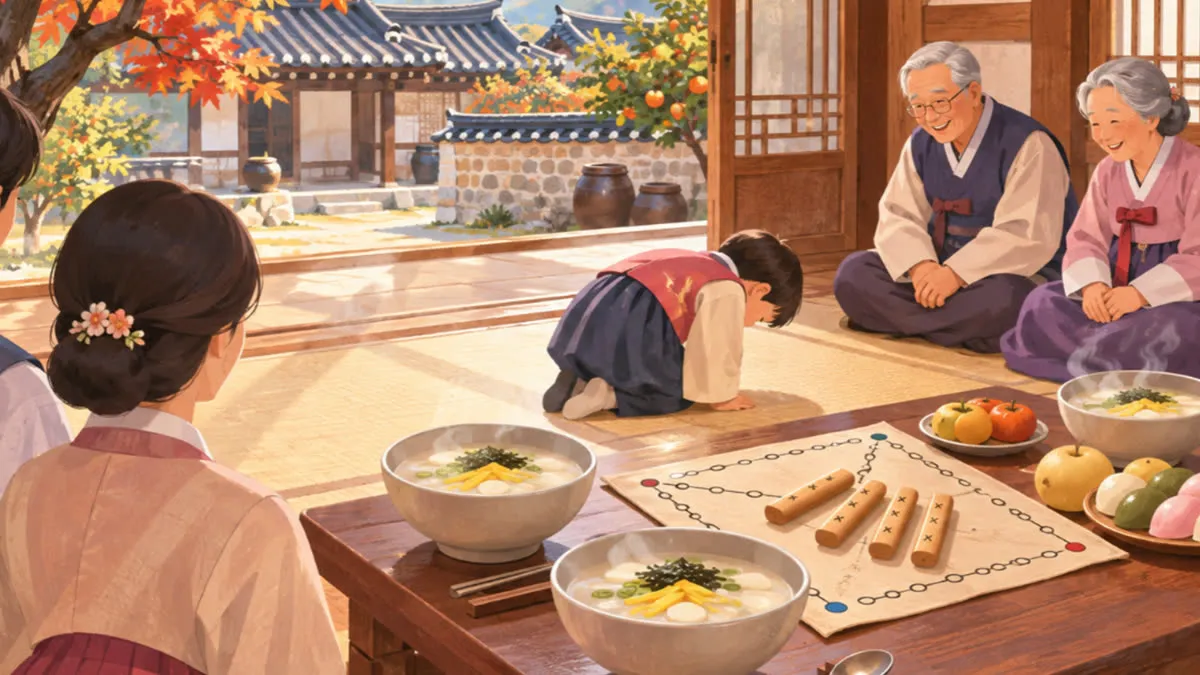
- Charye (차례): an ancestral memorial rite held on the morning of the main day. The family sets out a table of food for its ancestors.
- Sebae (세배): children make a deep bow to their elders. In return they get words of blessing and a cash gift called sebaetdon. Korea's culture ministry put the usual amount at 10,000 to 50,000 won, depending on the child's age (2022 figure).
- Tteokguk (떡국): soup with sliced rice cakes. Koreans have long said that eating it on Seollal makes you one year older.
- Yutnori (윷놀이): a board game where players throw four wooden sticks instead of dice. Museums run free holiday programmes built around it. At Seollal 2026, the National Folk Museum of Korea held a yutnori-themed event, and most museum programmes needed no booking.
The standard greeting is saehae bok mani badeuseyo (새해 복 많이 받으세요), roughly "receive many blessings in the new year." You can say it to hotel staff, a host family or colleagues in the days around Seollal.
Why Chuseok is not quite "Korean Thanksgiving"
The name Chuseok (추석) is written with the Chinese characters for "autumn" and "evening." Its other name, Hangawi (한가위), is an old Korean word meaning "the great middle of autumn." Chuseok falls on the 15th day of the 8th lunar month, which lands between mid-September and mid-October. Like Thanksgiving, it is a family feast tied to the harvest. The timing is different, though. Thanksgiving comes after the harvest. Chuseok comes while the rice is still in the fields, so it is part thanks and part prayer for a good crop. It is also a day for honouring ancestors.
- Charye: the same morning rite as at Seollal, with the year's first fruits on the table.
- Beolcho (벌초): families visit their ancestors' graves, often on grassy hillsides, and clear the weeds. This is part of why traffic out of Seoul and Gyeonggi gets so heavy.
- Songpyeon (송편): small half-moon rice cakes filled with sesame, chestnut or sweet red beans. They are steamed on a bed of pine needles.
Not every family keeps these customs. Many Christian families skip charye for religious reasons. More families now meet at a restaurant instead of at home, and a growing number travel abroad over the break.
What is open over the holiday in Seoul
The main day is the quietest. Seoul's listings for Chuseok 2026 (September 24–26, with the main day on September 25) show the usual pattern:
- Open every day of the holiday: Namsangol Hanok Village (09:00–21:00), Unhyeongung (09:00–21:00, but only until 18:00 on September 24) and the Seoul Museum of History (09:00–21:00, Thursdays until 18:00).
- Closed on the main day only: the Hanyangdoseong (Seoul City Wall) ruins exhibition hall and Nodeul Island.
- Closed most of the holiday: Seoul Library was shut September 24–26.
- Government offices close on every official holiday day, including the substitute holiday.
- Small family-run restaurants and market stalls set their own holiday hours. Check that day's hours on Naver Map or Kakao Map before you go. Our Naver Map English guide shows where the hours appear.
Are palaces free during Chuseok and Seollal?
They were at both holidays in 2026. The Korea Heritage Service opened Gyeongbokgung, Changdeokgung, Deoksugung, Changgyeonggung, Jongmyo Shrine and the 22 Joseon royal tombs free of charge on these dates:
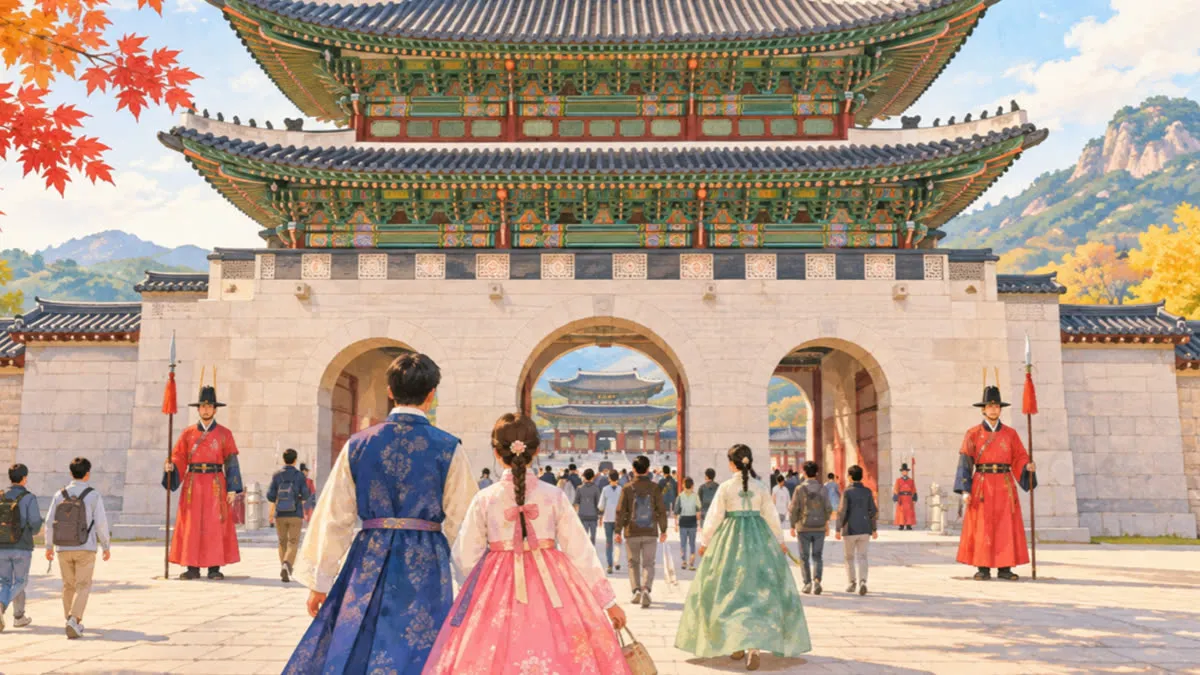
- Seollal 2026: February 14–18
- Chuseok 2026: September 24–27
Before you go:
- The Secret Garden (Huwon) at Changdeokgung is not included. It still needs its own paid ticket.
- Jongmyo Shrine drops its timed tours. You can walk in without a booking and explore on your own. At Chuseok 2026 it was open 09:00–18:00, with last entry at 17:00.
- The day after the free period is a closing day. After Seollal 2026, all of these sites closed on February 19.
- Gyeongbokgung gave out free New Year prints (sehwa) in Heungnyemun Square at Seollal 2026. Copies were handed out twice a day from February 16 to 18, 6,000 in total, first come, first served.
The free dates are confirmed for each holiday separately. Check the Royal Palaces and Tombs Center site (royal.khs.go.kr) or call 02-6450-3800 before you plan around them.
How to book Korail trains for Chuseok and Seollal
Holiday trains sell out in a special pre-sale held two to three weeks before the holiday. Here is how the Chuseok 2026 sale worked. It covered trains running September 23–27.
- Become an integrated Korail member (통합회원) first. Only integrated members could book. Existing Korail members were switched over automatically. Members of SR, the company that runs SRT trains, had to convert through the Korail+ app or a web page linked from korail.com.
- Priority booking ran September 3–4, from 09:00 to 15:00. It was open to people aged 65 and over, registered disabled people, national merit holders eligible for travel support, and pregnant women. Each booking had to be finished within 5 minutes of entering the booking page (30 minutes for people with severe disabilities).
- General booking ran September 7–11, from 07:00 to 13:00, with each booking finished within 3 minutes. Each day covered different lines. September 7 was for regular trains (ITX-Saemaeul, ITX-Maeum, Mugunghwa). September 8–10 covered KTX lines in groups, including Suseo-station KTX trains on September 10. September 11 was for the Gyeongbu Line KTX.
- Booking channels: the Korail+ app, the holiday booking page on www.korail.com, or the holiday booking phone line 1544-8545 for people who do not book online.
- Pay by the deadline. Payment opened September 12. General-booking tickets had to be paid by September 15, and priority tickets by September 18.
If you do not have a Korail integrated membership, plan as if holiday-week trains are already full. Korea JoongAng Daily reports that traffic to and from the countryside can be up to three times the usual level, and that trains, buses and even domestic flights fill up. Book trips to Busan, Gyeongju or Jeju for the week before or after the holiday instead.
Late subway and bus hours in Seoul on the last holiday days
Seoul runs later trains and buses at the end of the holiday, when people come home. For Chuseok 2026, the city did this on September 26–27:
- Subway: last trains on Lines 1–9, the Ui-Sinseol Line and the Sillim Line ran late enough to reach the end of the line at 1:00 a.m. That added 128 trips over the two days.
- City buses: on 121 routes, the last bus passed Seoul, Yongsan, Yeongdeungpo, Cheongnyangni and Suseo stations, and the Express Bus, Dong Seoul and Nambu terminals, at 1:00 a.m.
- Night (N) buses: all 14 routes ran as usual, from 23:00 to 06:00.
The city posts each holiday's transport plan on seoul.go.kr. If you arrive after these times, see our Seoul taxi guide for late-night fares.
If you get sick during Chuseok or Seollal
Most clinics close, but some hospitals, clinics and pharmacies take turns staying open, and large hospitals keep their emergency rooms open 24 hours.
- Find what is open: the E-Gen holiday page (www.e-gen.or.kr) shows clinics and pharmacies open near you. For Chuseok 2026, Seoul also posted a downloadable list on its holiday page.
- 24-hour emergency rooms in Seoul included Seoul Medical Center (02-2276-7000), Seoul National University Hospital (1588-5700), Asan Medical Center (1688-7575) and Severance Hospital in Sinchon (1599-1004).
- Call: 119 for emergencies and medical advice, 120 for the Seoul Dasan call centre, or 1330 for the Korea Travel Hotline, which has English-speaking staff.
- Phone before you go. Opening hours on holiday rotas can change.
- For minor problems: shops registered to sell basic over-the-counter medicines, mostly convenience stores, stay open. Seoul publishes a list of them.
Our emergency numbers guide explains how 119 and the English-speaking lines work.
If you live in Seoul: rubbish collection over the holiday
Each district (gu) sets its own collection days. At Chuseok 2026, only a few districts collected on each of September 24, 25 and 26, and only Gangdong-gu collected on the main day. All 25 districts collected on Sunday, September 27, and normal service came back on Monday, September 28. Check the notice in your building or your gu office website, and keep bags in until your district's collection day.
Should you visit Korea during Chuseok or Seollal?
Yes, if you are staying in Seoul and want free palaces and late transport home. No, if your plans depend on long-distance trains during the holiday week. Spend the holiday days on palaces and museums, and schedule trips outside Seoul for the week before or after. For month-by-month weather and crowds, see Best Time to Visit Korea.
Sources
Last checked: — Prices, hours and rules in Korea change often; check the official pages below before you go.
- Korea Astronomy and Space Science Institute: 2027 calendar data
- Korea Astronomy and Space Science Institute: 2028 calendar data
- Korea Policy Briefing: Korea AeroSpace Administration announces 2027 calendar (June 29, 2026)
- Korea Law Information Center: Regulations on Holidays of Government Offices (substitute holidays)
- Newsis: free palaces, tombs and museums over Seollal (Feb 2026)
- Kyunghyang Shinmun: palaces, Jongmyo and royal tombs free over Chuseok 2026 (Sept 2026)
- Seoul Mediahub: Chuseok 2026 palace visits (Sept 30, 2026)
- Royal Palaces and Tombs Center (Korea Heritage Service)
- Seoul Metropolitan Government: 2026 Chuseok holiday information
- Segye Ilbo: Korail Chuseok ticket booking schedule (Aug 2026)
- Korea JoongAng Daily: If it's not Korean Thanksgiving, then what is Chuseok?
- Korea.net: Lunar New Year festivities across the country
- Korea.net: Making rice cake soup on Seollal
- Ministry of Culture, Sports and Tourism (KOCIS): Korea celebrates Seollal
Facts were checked against the sources above, and the article was written by Seoul Sidekick with the help of AI tools. Report an error